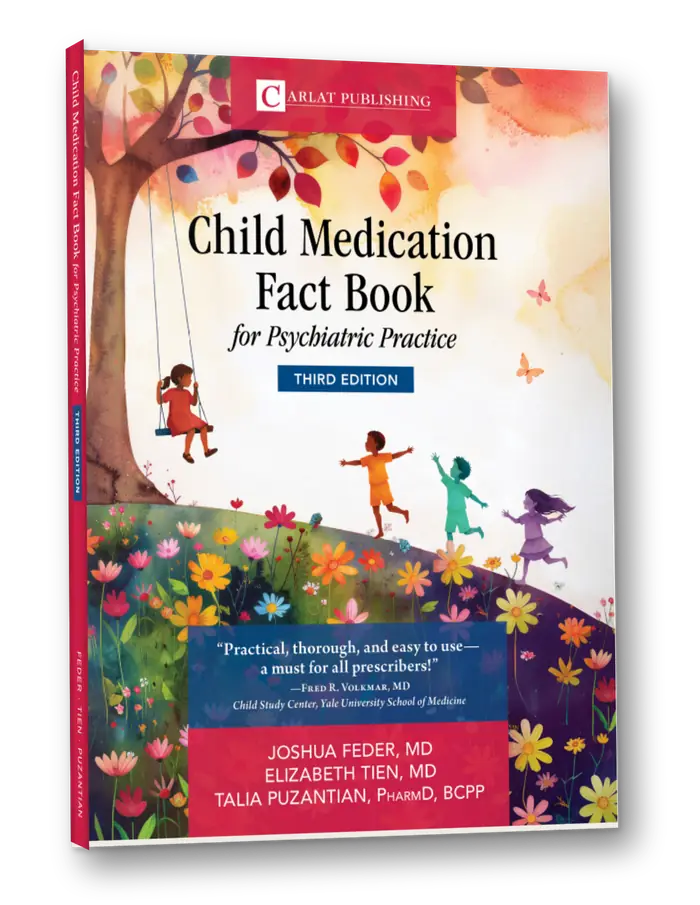
Child Medication Fact Book for Psychiatric Practice, Third Edition (2027) - Perfect Bound
Product Details
Black Friday — Friday, November 27 Only
$89.95 $79.95
Save $10 on the new Third Edition today. The discount is applied automatically at checkout — no code needed. On Saturday the price returns to $89.95.
This version of the book includes:
- A perfect-bound print copy, shipping by the end of December 2026
- Instant access to the full PDF/eBook — readable on your phone, tablet, or desktop
- Instant access to the 10-credit CME Post-Test
- You do not have to wait for the print copy to arrive. You can start reading and claim CME the moment you order.
Other formats of this book:
Want a copy that lies flat at the desk? Get the spiral-bound version.
Just want to read it now? Get the PDF/eBook version.
Note on the Web App
Previous editions of this book included a Child Medication Fact Book web app. Individual book apps have been combined into the new Carlat Psychiatry Toolkit subscription, which includes updated fact sheets from all of the Carlat Psychiatry Fact Books.
The Facts You Need Before You Prescribe to a Child
There are roughly 14 child psychiatrists for every 100,000 children in the United States, and most prescribing for kids is done by clinicians who were never meant to carry it alone. This fact book covers all the important facts, from cost to pharmacokinetics, about the medications most commonly prescribed in child and adolescent psychiatry. Composed of single-page, reader-friendly fact sheets and quick-scan medication tables, it offers guidance, clinical pearls, and bottom-line assessments of 77 of the most common medications you use and are asked about in your practice.
Click here to view the table of contents, see the fact sheet format, and browse sample pages.
Inside this book, you'll find:
- 77 medication fact sheets covering ADHD medications, antidepressants, antipsychotics, anxiolytics and hypnotics, complementary treatments, mood stabilizers, and substance use medications
- NEW: 33 online medication fact sheets written for families, in plain language a parent can read and take home
- NEW: Guidance on reducing and discontinuing medications — when to reassess, how to taper, and what to expect on the way down
- 14 treatment algorithms to guide patient care, each placing medication inside a whole plan alongside non-pharmacologic approaches
- The latest on new medications such as centanafadine (Simtriyo) and cariprazine (Vraylar)
- 13 quick-scan medication reference tables, including stimulant conversion, metabolic monitoring, relative side effects, and benzodiazepine dosage equivalencies
- 12 appendices including rating scales, the AIMS, blood pressure parameters for children, growth and BMI charts, lab monitoring, informed consent, mental health apps, drug interactions, pregnancy and lactation, controlled substance schedules, and pharmacogenetic testing
- NEW: An appendix of landmark studies in child and adolescent psychiatry, with eight corresponding tables
Get the information you need at a glance: off-label uses • dosage and generic availability • mechanism of action • cost information • bottom-line impression.
Written by experienced practicing clinicians, for the practice you actually work in.
What's Covered
ADHD Medications
Amphetamine (Adzenys XR-ODT, Dyanavel XR, Evekeo) • Atomoxetine (Strattera) • Centanafadine (Simtriyo) • Clonidine (Catapres, Kapvay, Onyda XR) • Dexmethylphenidate (Azstarys, Focalin) • Dextroamphetamine (Dexedrine, ProCentra, Zenzedi) • Dextroamphetamine Transdermal (Xelstrym) • Guanfacine (Intuniv, Tenex) • Lisdexamfetamine (Vyvanse) • Methamphetamine (Desoxyn) • Methylphenidate IR and ER (Methylin, Ritalin, Concerta, others) • Methylphenidate Transdermal (Daytrana) • Mixed Amphetamine Salts (Adderall, Mydayis) • Viloxazine XR (Qelbree)
Antidepressants
Bupropion (Wellbutrin) • Citalopram (Celexa) • Desvenlafaxine (Pristiq) • Duloxetine (Cymbalta, Drizalma Sprinkle) • Escitalopram (Lexapro) • Fluoxetine (Prozac) • Fluvoxamine (Luvox) • Mirtazapine (Remeron) • Paroxetine (Paxil) • Selegiline Transdermal (EMSAM) • Sertraline (Zoloft) • Tricyclic Antidepressants • Venlafaxine (Effexor)
Antipsychotics
Aripiprazole (Abilify) • Asenapine (Saphris, Secuado) • Brexpiprazole (Rexulti) • Cariprazine (Vraylar) • Chlorpromazine (Thorazine) • Clozapine (Clozaril, Versacloz) • Haloperidol (Haldol) • Lurasidone (Latuda) • Olanzapine (Lybalvi, Symbyax, Zyprexa) • Paliperidone (Invega) • Perphenazine (Trilafon) • Quetiapine (Seroquel) • Risperidone (Risperdal) • Ziprasidone (Geodon) • Long-Acting Injectable (LAI) Antipsychotics
Anxiolytics and Hypnotics
Antihistamines (doxylamine, hydroxyzine) • Buspirone (BuSpar) • Clonazepam (Klonopin) • Lorazepam (Ativan, Loreev XR) • Prazosin (Minipress) • Propranolol (Inderal) • Ramelteon (Rozerem) • Trazodone
Complementary Treatments
Lavender essential oil (CalmAid, Silexan) • L-methylfolate (Deplin) • Magnesium • Melatonin • N-acetylcysteine (NAC) • Omega-3 fatty acids (fish oil) • S-adenosyl-L-methionine (SAMe) • Saffron • St. John's wort • Vitamin D
Mood Stabilizers
Carbamazepine (Tegretol) • Lamotrigine (Lamictal, Subvenite) • Lithium (Eskalith, Lithobid) • Oxcarbazepine (Oxtellar XR, Trileptal) • Valproic Acid (Depakote)
Substance Use Medications
Acamprosate (Campral) • Buprenorphine (Brixadi, Sublocade) • Buprenorphine/Naloxone (Suboxone, Zubsolv) • Disulfiram (Antabuse) • Methadone (Methadose) • Naloxone (Narcan Nasal Spray, Kloxxado, others) • Naltrexone (ReVia, Vivitrol) • Nicotine gum, lozenge, nasal spray, and patch • Varenicline (Chantix)
14 Treatment Algorithms
ADHD • Depressive disorders • Psychosis • Autism support • Anxiety disorders • Insomnia • OCD • PTSD • Severe acute agitation • Catatonia • Bipolar disorder • Alcohol use disorder • Nicotine use disorder • Opioid use disorder
About the Authors
All three authors are experienced practicing clinicians who see patients and field these questions in their own clinics.
Joshua D. Feder, MD, is a child psychiatrist active in clinical practice, research, and advocacy. He serves as editor-in-chief of The Carlat Child Psychiatry Report and as an associate clinical professor at the UCSD School of Medicine.
Elizabeth Tien, MD, is a community psychiatrist at the Los Angeles County Department of Mental Health and a clinical assistant professor at Charles R. Drew University of Medicine and Science in Los Angeles, CA.
Talia Puzantian, PharmD, BCPP, is a professor of clinical sciences at Keck Graduate Institute School of Pharmacy in Claremont, CA. She is the deputy editor of The Carlat Report newsletters and co-author of the Medication Fact Book for Psychiatric Practice.
Drs. Feder, Tien, and Puzantian have disclosed no relevant financial or other interests in any commercial companies pertaining to this educational activity.
You must be logged in to your individual account to take the post-test. You will have two attempts to pass and must answer at least 75% of the questions correctly to earn credit. The Carlat CME Institute is accredited by the Accreditation Council for Continuing Medical Education (ACCME) to provide continuing medical education for physicians and maintains responsibility for this program and its content. The Carlat CME Institute is approved by the American Psychological Association to sponsor continuing education for psychologists. This enduring material is designated for a maximum of ten (10) AMA PRA Category 1 Credits™ or 10 CE for psychologists. Physicians and psychologists should claim credit commensurate with their participation. The American Board of Psychiatry and Neurology has reviewed the Child Medication Fact Book for Psychiatric Practice and has approved this program as part of a comprehensive Self-Assessment and CME Program, which is mandated by ABMS as a necessary component of maintenance of certification. This activity is available for CME credit for a defined period based on the date of publication, in accordance with accreditation requirements. The post-test must be completed prior to the expiration date; after that time, CME credit will no longer be available.