• Home
  • Store
    • Total Access Subscriptions
    • Newsletter Subscriptions
    • Multimedia
    • Books
    • eBooks
    • ABPN SA Courses
    • Institutional Site Licenses
  • CME Center
  • Multimedia
    • Podcast
    • Webinars
    • Blog
  • Newsletters
    • General Psychiatry
    • Child Psychiatry
    • Addiction Treatment
    • Hospital Psychiatry
    • Geriatric Psychiatry
    • Psychotherapy and Social Work
  • Toolkit/AskCarlat AI
  • FAQs
  • Log In
  • Register
  • Welcome
  • Sign Out
  • Subscribe
Access Purchased Content
Home » Topics » Addiction Treatment » Files

Addiction Treatment

How to Use Phenobarbital to Manage Alcohol Withdrawal

November 2, 2023

Phenobarbital is becoming more popular as a strategy for managing alcohol withdrawal syndrome (AWS) as clinicians gain more experience with it. A recent retrospective study compared phenobarbital with lorazepam for AWS and found that patients using phenobarbital had a shorter length of stay (2.8 vs 3.6 days) as well as fewer readmissions and emergency room visits after discharge (Hawa F et al, Cureus 2021;13(2):e13282). From Treating Alcohol Use Disorder: A Fact Book (2023).

How to Conduct a Family Meeting

November 2, 2023

Including family meetings in your treatment of alcohol-using patients (or any psychiatric patients, for that matter) can help you better understand treatment challenges and therefore help achieve long-term sobriety. But it can be awkward to facilitate such meetings, especially if you haven’t done many. This fact sheet presents some useful tips. From Treating Alcohol Use Disorder: A Fact Book (2023).

Alcoholics Anonymous Meetings_ The Basics

November 2, 2023

Research has shown that consistent attendance at Alcoholics Anonymous (AA) meetings is at least as effective as any other treatment, and possibly more so. The two key ingredients of AA meetings are: ⦁ Making positive changes in social networks ⦁ Learning coping skills to maintain abstinence when in high-risk social situations. From Treating Alcohol Use Disorder: A Fact Book (2023).

How to Help Families of Alcohol Users_ An Overview

November 2, 2023

Families or friends of patients may ask you for advice about what they can do to help their loved one with alcohol use disorder (AUD). Some will be quite desperate for help, and may themselves be suffering from psychiatric illness— possibly aggravated by the patient’s behaviors. In this fact sheet we give you an overview of the different things you can suggest for family members. Some of these options are covered in more detail in individual fact sheets. From Treating Alcohol Use Disorder: A Fact Book (2023).

How to Quickly Develop a Therapeutic Alliance

November 2, 2023

Regardless of what kind of treatment you choose for your patient, it’s important to remind yourself of the key feature of any successful treatment—a good treatment alliance. From Treating Alcohol Use Disorder: A Fact Book (2023).

How to Manage Alcohol Withdrawal in Outpatient Settings

November 2, 2023

Outpatient managed withdrawal is best for patients who are medically healthy, have no history of seizures, have good psychosocial supports, are reliable (answer phone calls, follow instructions exactly, and return for appointments), and have no major or unstable mental illness. From Treating Alcohol Use Disorder: A Fact Book (2023).

How to Order Biomarkers of Alcohol Use Disorder

November 2, 2023

Biomarkers of alcohol use are sometimes helpful when we are not sure whether our patients are reliable in reporting their level of use. Here are two common situations where we might order a test: ⦁ Screening for ongoing alcohol use in a patient who is requesting controlled substance medications for a psychiatric issue ⦁ Monitoring for relapse in a patient who has been abstinent and who is in a mandated treatment program (such as part of probation or an employer-mandated program) From Treating Alcohol Use Disorder: A Fact Book (2023).

Alcohol Use Disorder_ Tips for the Initial Assessment

November 2, 2023

This fact sheet suggests a typical flow of questions during a conversational initial assessment of a patient’s alcohol use. While many of these questions can be used to establish a DSM-5 alcohol use disorder diagnosis, they are not explicitly tied to the DSM-5 criteria. To conduct a more formal interview based on the DSM-5, see “How to Ask DSM-5 Focused Questions in Alcohol Use Disorder.” From Treating Alcohol Use Disorder: A Fact Book (2023).

Alcohol Use Disorder Treatment_ An Overview

November 2, 2023

There are many approaches to treating alcohol use disorder (AUD), and the initial approach for any given patient will vary depending on the severity of their use, their experience with treatment, the existence of concurrent illness, etc. This fact sheet gives you a framework for choosing an initial treatment strategy based on how many of the 11 DSM-5 criteria for AUD the patient meets. From Treating Alcohol Use Disorder: A Fact Book (2023).

How to Ask DSM 5 Focused Questions for Alcohol Use Disorder

November 2, 2023

Alcohol use disorder (AUD), as defined in the DSM-5, includes 11 criteria. While most experienced clinicians can diagnose AUD without going through a formal checklist of DSM symptoms, we suggest you try using this sheet during interviews. You are likely to find it helpful in at least two ways. First, you can use the criteria to more accurately categorize the severity of your patient’s AUD: ⦁ Mild: two DSM-5 criteria ⦁ Moderate: three to five DSM-5 criteria ⦁ Severe: more than five DSM-5 criteria Second, you can use the criteria to show your patient that there are relatively objective medical symptoms leading to the diagnosis of AUD. This lessens the stigma attached to the diagnosis and shows that you are a well-trained professional, enhancing your credibility and hopefully helping your patient trust your recommendations. From Treating Alcohol Use Disorder: A Fact Book (2023).

Previous 1 2 3 4 5 6 7 8 9 Next
Try The New AskCarlat AI

Ask any clinical question—our AI responds using only the peer-reviewed, editorially vetted content from Carlat Publishing.

Available In The Carlat Toolkit
Free Psychiatry Updates
The latest unbiased psychiatric information sent to your inbox.
Specify Your Interests
Featured Book
  • MFB8e_SpiralCover.png

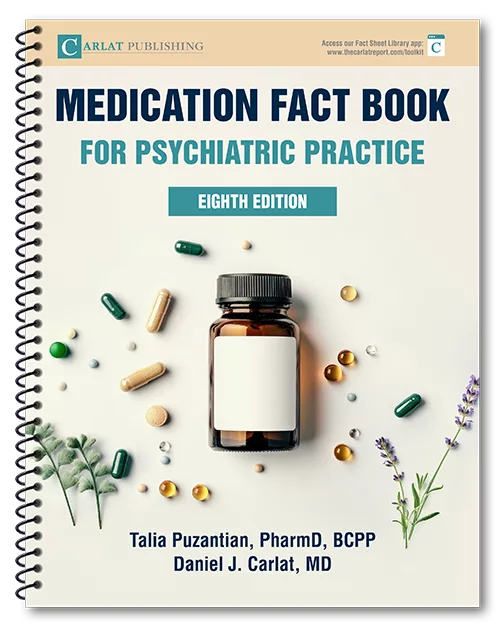
    Medication Fact Book for Psychiatric Practice, Eighth Edition (2026)

    Updated 2026 prescriber's guide.
    READ MORE
Featured Video
  • KarXT (Cobenfy)_ The Breakthrough Antipsychotic That Could Change Everything.jpg
    General Psychiatry

    KarXT (Cobenfy): The Breakthrough Antipsychotic That Could Change Everything

    Read More
Featured Podcast
  • shutterstock_2839304851.jpg
    Addiction Treatment

    Medication or Therapy? A Clinical Framework for Substance Use Disorders

    Listen now
Recommended
  • Join Our Writing Team

    July 18, 2024
    WriteForUs.png
  • Insights About a Rare Transmissible Form of Alzheimer's Disease

    February 9, 2024
    shutterstock_2417738561_PeopleImages.com_Yuri A.png
  • How to Fulfill the DEA's One Time, 8-Hour Training Requirement for Registered Practitioners

    May 24, 2024
    DEA_Checkbox.png
  • Join Our Writing Team

    July 18, 2024
    WriteForUs.png
  • Insights About a Rare Transmissible Form of Alzheimer's Disease

    February 9, 2024
    shutterstock_2417738561_PeopleImages.com_Yuri A.png
  • How to Fulfill the DEA's One Time, 8-Hour Training Requirement for Registered Practitioners

    May 24, 2024
    DEA_Checkbox.png
  • Join Our Writing Team

    July 18, 2024
    WriteForUs.png
  • Insights About a Rare Transmissible Form of Alzheimer's Disease

    February 9, 2024
    shutterstock_2417738561_PeopleImages.com_Yuri A.png
  • How to Fulfill the DEA's One Time, 8-Hour Training Requirement for Registered Practitioners

    May 24, 2024
    DEA_Checkbox.png

About

  • About Us
  • CME Center
  • FAQ
  • Contact Us

Shop Online

  • Newsletters
  • Multimedia Subscriptions
  • Books
  • eBooks
  • ABPN Self-Assessment Courses

Newsletters

  • The Carlat Psychiatry Report
  • The Carlat Child Psychiatry Report
  • The Carlat Addiction Treatment Report
  • The Carlat Hospital Psychiatry Report
  • The Carlat Geriatric Psychiatry Report
  • The Carlat Psychotherapy Report

Contact

carlat@thecarlatreport.com

866-348-9279

PO Box 626, Newburyport MA 01950

Follow Us

Please see our Terms and Conditions, Privacy Policy, Subscription Agreement, Use of Cookies, and Hardware/Software Requirements to view our website.

© 2026 Carlat Publishing, LLC and Affiliates, All Rights Reserved.