RSS
RSS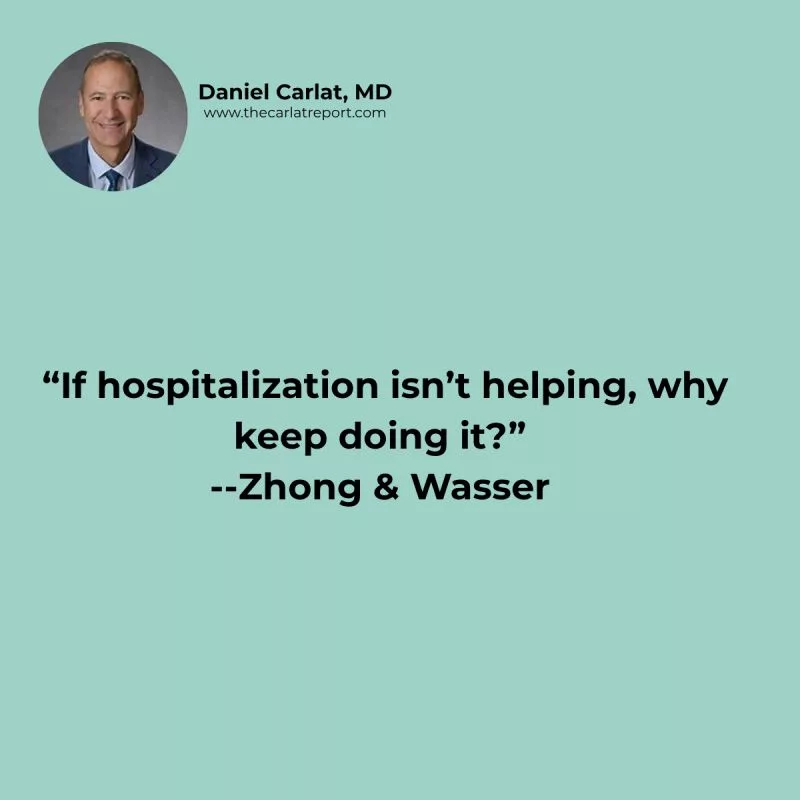

She’d threatened her husband.
She believed her mental health workers were trying to poison her, so she refused to let them in.
She kept getting admitted for agitation—again and again.
“You have no right!” she’d shout. And by day 3 or 4, she was calm, back on meds, ready for discharge.
Then the cycle began again.
▸ Same patient
▸ Same pattern
▸ Same result
And quietly, as a team, we’d ask: Is this really helping?
Carlat Clinical Dispatch
This post is part of a new series where I reflect on the most thought-provoking clinical ideas from recent issues of our newsletters.
Today’s comes from a powerful Q&A on involuntary hospitalization and grave disability in the current issue of The Carlat Hospital Psychiatry Report, featuring Drs. Rocksheng Zhong and Tobias Wasser.
Their argument is straightforward but provocative:
For some patients, repeated involuntary hospitalization may not help—and may, in fact, cause harm.
It’s not that we’re using the wrong medication.
It’s that we may be using the wrong tool.
Zhong and Wasser make the case that:
▸ Hospitalization has become a “default intervention” for grave disability
▸ But for some patients, it has little to no lasting effect
▸ It burns out staff, erodes trust, and costs liberty
▸ And worst of all—it may be futile
Their core question:
“If hospitalization isn’t helping, why keep doing it?”
They suggest a shift in mindset, borrowed from the rest of medicine:
→ In oncology, we stop chemo for the terminally ill.
→ In psychiatry, we rarely say: this intervention is futile.
But maybe we should.
This doesn’t mean giving up.It means rethinking what “help” looks like:
▸ Robust community supports like ACT teams
▸ Involuntary outpatient commitment—when backed by strong infrastructure
▸ Peer support specialists: individuals with lived experience who can build trust
▸ Co-locating services: mental health, housing, employment, social engagement
▸ Dedicated investment in recovery-oriented systems
▸ Practical tools like long-acting injectables—used thoughtfully, with consent
▸ And yes—showers, meals, and warm clothes. Basic needs, met without coercionIt also means:
▸ Careful, defensible documentation of clinical reasoning
▸ Transparent communication with families when involuntary treatment won’t help
▸ Collaborating with outpatient teams, even if options are limited
▸ Advocating for alternatives in your notes and team meetings
These steps aren’t just protective—they’re proactive.
Where do you see the line between “doing something” and “doing good”?
What helps you decide when hospitalization has stopped helping?
Follow me (Daniel Carlat, MD) for grounded reflections on psychiatry, systems, and the hard choices we don’t talk about enough.
And if this gave you language for something you’ve felt—share it with a colleague who’s been there too.
Join the conversation on LinkedIn with Dr. Carlat.