RSS
RSS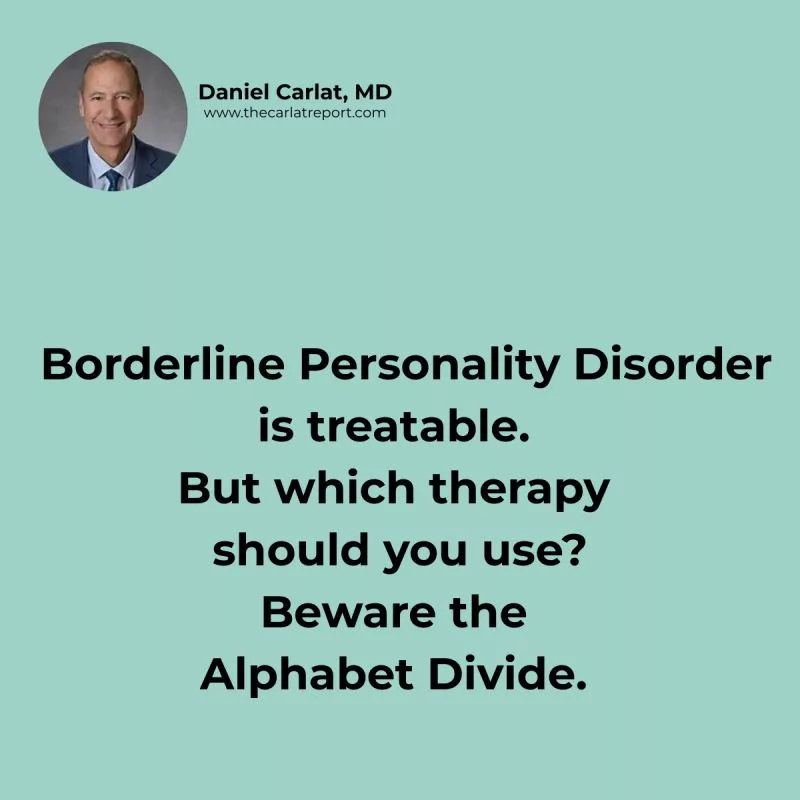

_-The-Breakthrough-Antipsychotic-That-Could-Change-Everything.webp?t=1729528747 "KarXT (Cobenfy)_ The Breakthrough Antipsychotic That Could Change Everything.jpg")
You’ve just given a preliminary diagnosis of borderline personality disorder.
Now what?
▸ DBT?
▸ TFP?
▸ MBT?
▸ Schema therapy?
▸ GPM?
In a recent episode of the Carlat Psychotherapy Podcast, Dr. Abigail Rasol interviews Dr. Kenneth Levy about treatment for borderline personality disorder (BPD). (https://lnkd.in/e-c4Zm3F). It’s a practical, evidence-based overview that offers clinicians something we don’t get enough of: clarity without oversimplification.
There are five evidence-based psychotherapies for BPD:
▸ Dialectical Behavior Therapy (DBT)
▸ Mentalization-Based Treatment (MBT)
▸ Transference-Focused Psychotherapy (TFP)
▸ Schema-Focused Therapy (SFT)
▸ Good Psychiatric Management (GPM)
These treatments differ in technique and style.
DBT emphasizes structure, skills, and behavioral targets.
MBT helps patients reflect on mental states—their own and others’.
TFP focuses on the therapeutic relationship as a way to explore internal conflicts.
SFT combines cognitive, behavioral, and experiential techniques to modify deeply held schemas.
GPM offers a practical, generalist approach that emphasizes psychoeducation, case management, and relationship stability.
But as Dr. Levy points out, these treatments have more in common than not.
And the research bears that out.
Effectiveness is roughly equal across models.
What they share matters:
→ A coherent clinical model
→ Structured, boundaried treatment
→ Emphasis on therapist training and fidelity
→ Focus on the therapeutic relationship—especially ruptures and repairs
This convergence is part of what makes the divide in the field so striking.
Dr. Levy calls it the “alphabet divide.”
Many therapists learn one model—and stick with it.
But patients don’t always improve in the first treatment they try.
Roughly 50–60% show partial improvement within a year. Some stall. Others drop out.
Knowing multiple models—or at least understanding their core principles—helps us adapt.
It also helps us avoid the trap of treating our training as the treatment.
Sometimes a structured skills-based approach like DBT is the right first step.
Other times, a patient may benefit more from a relational or exploratory approach.
And sometimes the best move is to shift course—not because treatment has failed, but because the patient is now ready for a different kind of work.
▸ Which BPD model have you found most clinically useful—and where have you had to adapt?
▸ If this perspective helped clarify a complex treatment landscape, feel free to share it.
↳ If this resonated, feel free to share.Follow me (Daniel Carlat, MD) for reflections on practical psychiatry.
Join the conversation on LinkedIn with Dr. Carlat.