RSS
RSS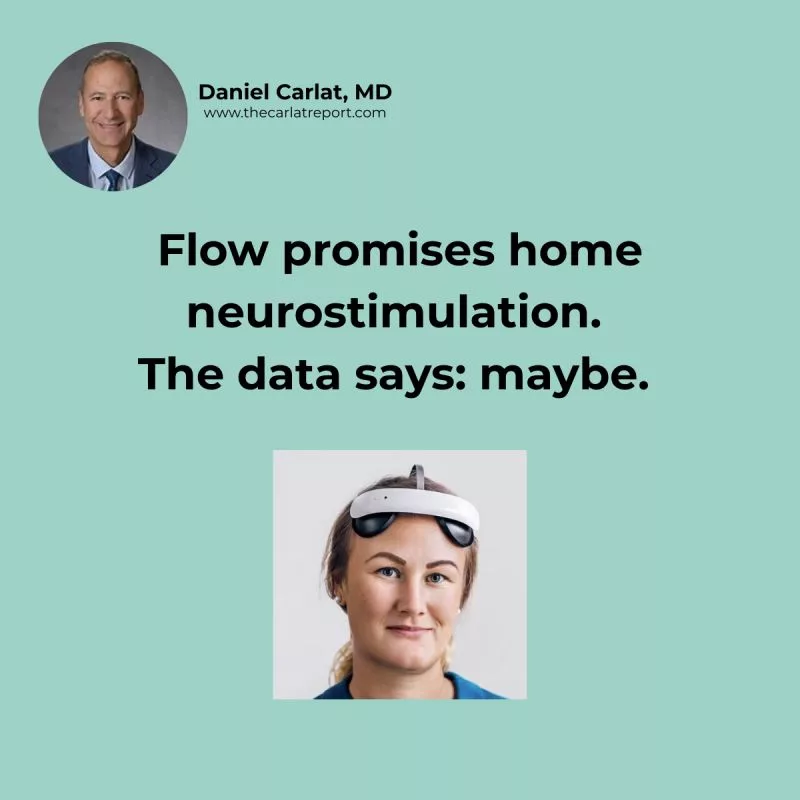

“FDA approved.”
That’s how the Flow device is often described in the media.
In an earlier version of this post, I wrote that Flow was FDA cleared, not approved. After looking more closely, I realized that was no longer accurate.
In December 2025, Flow did in fact receive FDA Approval, based on data from the Empower trial. Before that, it had been marketed under FDA clearance—a lower evidentiary bar.
That correction matters—and it sharpens the question many subscribers have been asking me:
How much does FDA approval tell us about real‑world effectiveness?
Here’s a quick clinical breakdown.
▸ Flow is a wearable headset delivering very low-intensity electrical current to the frontal cortex—targeting areas believed to be underactive in depression.
▸ The protocol is 30 minutes a day, around 5 days a week, for several weeks. (Specifics vary.)
▸ It’s being marketed as “the first non-drug, at-home treatment for depression.”
So what’s the evidence behind the approval?
▸ One pivotal randomized controlled trial (the Empower trial) enrolling 174 patients, comparing Flow to a sham condition
→ Patients had uncomplicated major depression
→ Some remained on stable antidepressants
→ Results showed modest symptom improvement
→ Prior to Empower, only a small open‑label feasibility study (n=26) and a few descriptive case series—encouraging, but uncontrolled and not designed to establish efficacy
More importantly, there was evidence of unblinding. The FDA explicitly noted that the clinical benefit was “moderately uncertain,” citing both the unblinding and the mixed broader literature on this approach.
So where does that leave us?
Flow is probably less effective than antidepressants, and clearly less effective than TMS (transcranial magnetic stimulation). It’s also plausible that much of the observed benefit reflects placebo effects—especially given the unblinding.
And yet…It may be reasonable for certain patients:
→ Moderate depression
→ Not treatment-resistant
→ Preference for non-pharmacologic options
The more a device leans on marketing, the more we have to lean on evidence.
This isn’t about being for or against new tools. It’s about understanding what we’re actually offering our patients—and how likely it is to help.
Curious to hear:
Have you had patients ask about Flow or other brain stimulation devices lately?
→ Share this if it helps bring clarity to a murky topic.
→ Follow Dr. Carlat for reflections on practical psychiatry and where the evidence meets the exam room.