RSS
RSS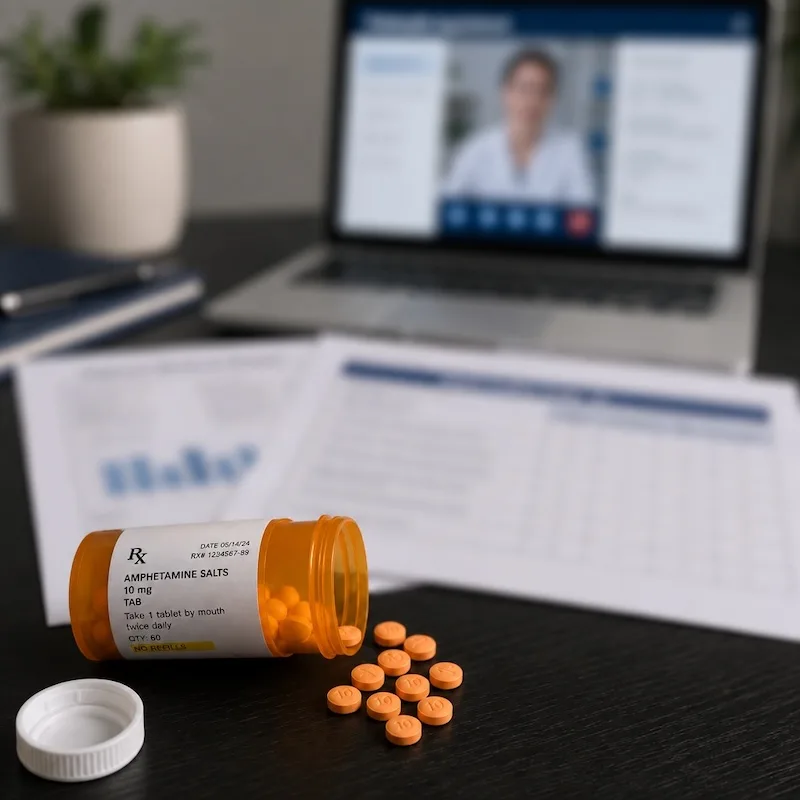
_-The-Breakthrough-Antipsychotic-That-Could-Change-Everything.webp?t=1729528747 "KarXT (Cobenfy)_ The Breakthrough Antipsychotic That Could Change Everything.jpg")
A Silicon Valley founder built a telehealth company to make ADHD treatment as easy as ordering takeout, until federal prosecutors traced 37 million pills of Adderall back to the clinic. We follow Done from venture-backed startup to criminal conviction, and ask what the case means for how we diagnose and treats ADHD. Plus: a new FDA approval adds a third option to the ADHD reuptake-inhibitor family.
Publication Date: 09/13/2026
Duration: 13 minutes, 34seconds
Transcript:
CHRIS AIKEN: Last month, the feds pulled the plug on a large telehealth practice that focused on ADHD. Here's what went wrong. Welcome to the Carlat Psychiatry Podcast, keeping psychiatry honest since 2003. I’m Chris Aiken, the editor-in-chief of the Carlat Report.
KELLIE AIKEN: And I’m Kellie Aiken, a psychiatric NP and a dedicated reader of every issue. On July 7, 2026, a federal judge sentenced Ruthia He (pronounced "Huh") and David Brody to 2 to 6 years in prison. Their crime: conspiring to distribute more than 37 million pills of Adderall. Huh founded Done, a large telehealth company, and Dr. Brody ran its clinical operations. The case touches how we diagnose ADHD, how we treat it, and how much power a corporate leader can hold over the clinicians on staff. We’ve interviewed clinicians and corporate leaders at Done; pored through court transcripts; and in the next three episodes we’re going to tell that story with some clinical pearls along the way. But first, a preview of the CME quiz. You'll find the link in the show notes, and the answer in the research update at the end of the episode.
1. How does the efficacy of centanafadine (Simtriyo), a triple-reuptake inhibitor recently approved for ADHD, compare to other treatments?
A. It is more effective than atomoxetine or viloxazine
B. Its effect size is similar to that of atomoxetine and viloxazine
C. Its effect size is similar to that of stimulants
D. It is effective in children but not adults
CHRIS AIKEN: In 2019, Ruthia He wanted to make art. She'd just left a job as a product designer at Facebook, where she built photo-sharing apps like Quick Camera and Slideshow. Creative and disciplined, Huh started making apps as a college student in China, then moved to the US for a master's in product development at Carnegie Mellon, the same school that produced Andy Warhol. Every morning at 7 am, she wrote down what she wanted to accomplish that day. Her diary entries increasingly turned toward creative directions:
KELLIE AIKEN: "I want to follow my heart and create something that only I and a few people will appreciate and other people will likely not give a shit... [like] a hipster music video, or a piece of 3D rendering."
CHRIS AIKEN: But the project she eventually arrived at would matter to a lot of people. It would cause pharmacies to run out of stock, send patients scrambling for refills, and draw the Department of Justice onto her trail. Huh had spotted a problem she thought Silicon Valley could fix: getting ADHD medication was hard. You needed insurance. You needed an appointment, then time off work to make it. You needed a doctor who believed your symptoms, and then you got treated like a drug seeker every time you switched pharmacies or asked for an early refill. She was going to make everything OK. Yes! That’s what she’d call it: Okay Health. No wait, that sounds a little mediocre. Sure, people want to be OK, but what do people with ADHD really want? They can’t prioritize. They can’t focus. They can’t get anything Done. That was it. Done. She would get it done – starting where it mattered – with the prescription, and on February 26, 2020, she registered the new telehealth company. Done., with a period on the end.
KELLIE AIKEN: Huh’s timing was impeccable. She registered Done as COVID was brewing, just a month after the federal government lifted the telehealth laws that required in-person appointments for controlled substances under the Ryan Haight Act. That meant Done could reach patients nationwide with just a handful of clinicians, as long as those clinicians held licenses in each state.
CHRIS AIKEN: That was six years ago. Since then, the DEA has renewed the suspension of Ryan Haight four times, each time causing a wave of anxiety among patients and providers as to what will be the fate of telehealth. The current extension expires December 31, 2026. There are hints the DEA may require special licenses or specific EMRs for telehealth going forward, but that's speculation. Here's where the law stands now. You can prescribe controlled substances without an in-person visit if you hold a DEA license in the state where the patient is located. Telehealth happens where the patient is, not where you are. And if the control is a stimulants, you can only write for a three-month supply at a time. When writing for controls, the visit needs both audio and video. Audio-only visits are allowed for controlled opioid medications used to treat opioid use disorder, like Suboxone.
KELLIE AIKEN: With financial backing from venture capitalists, Done was up and running. The company spent $40 million on ads across Google, Facebook, and TikTok, promoting quick ADHD evaluations and easy access to medication, always with the $199 intake fee cut in half in a never-ending sale. No insurance? No time for follow-up visits? Done had you covered, for a $79-a-month membership. Investors included David Sacks, who later served as President Trump's cryptocurrency czar, and former NFL players like Joe Montana.
CHRIS AIKEN: It all sounds well-intentioned, but Huh is now serving time in federal prison. Over this series, we'll unpack what went wrong. It's easy to write off the C-suite at Done as a group of sociopaths, but I'll resist that. The road to healthcare fraud is often paved with good intentions, and any of us could take a wrong turn on it. Here's an experiment that shows why.
KELLIE AIKEN: In 2013, two Swiss economists designed a dice-rolling game that measures lying. Here's how it works. You roll a die under a cup, so only you see the number. The higher the roll, the higher your cash reward. People cheat: about 60% of them do, saying they rolled a six when they only rolled a two. The experimenters catch this by aggregating the rolls. Sixes turn up far more often than chance allows. But here’s where it gets dicey. Let’s change the rules so you no longer get all of the payout. Part of the rewards go to charity. Under these terms, people lie a lot more, even though they are keeping less of the cash pile. The takeaway – people lie more because they have a noble cause to cover their shame. They are getting rich while helping people in need. The setup looks a lot like what goes on with medical fraud.
CHRIS AIKEN: And that's what makes healthcare fraud such a slippery slope. Done framed itself as a mission-driven company. People with ADHD have to push through layers of red tape to get treatment, and they start with less frontal lobe reserve than most. Miss an appointment, run out of medication, and suddenly you lack the organization you need to reschedule and restart. Done set out to remove that friction, and turn a profit along the way. The die was cast.
KELLIE AIKEN: Next week, we look at the tactics behind the operation: The advertisements and rating scales that brought patients in, and the carrots and sticks that kept clinicians in line.
[Done advertisement]
While the DOJ was prosecuting Done for overprescribing amphetamines, the FDA was reviewing a new drug application for ADHD. On July 24, the agency approved centanafadine, brand name Simtriyo, for children and adults with ADHD. It's the first triple-reuptake inhibitor for the disorder, though whether it will be scheduled like a stimulant is still unclear. Our research update looks at a new meta-analysis of the trials by Muneeb Muneer and colleagues in the Psychopharmacology Bulletin. The trials were industry funded, but the analysis was not.
CHRIS AIKEN: Centanafadine joins a growing family of reuptake inhibitors for ADHD. Atomoxetine works through norepinephrine. Viloxazine works through norepinephrine and serotonin, and centanafadine adds dopamine to the mix. But does the extra dopamine make a difference?
KELLIE AIKEN: The meta-analysis pooled five trials, just under 2,000 patients total. The effect size came out to 0.37, small, and about the same as atomoxetine and viloxazine. So the extra dopamine didn't bring a bigger effect. Centanafadine improved inattention, hyperactivity, executive function, and emotional dysregulation. It did not improve defiance or aggression, but those symptoms were low to start with in this group. Higher doses outperformed lower doses.
CHRIS AIKEN: Where centanafadine stands out is speed. Meaningful effects showed up within one to two weeks, which is possibly faster than viloxazine and definitely faster than atomoxetine, which takes four to six weeks to show its full effects. Centanafadine might be better tolerated than the other two, with less nausea and fatigue, but that comes from indirect comparisons in an industry-funded analysis.
CHRIS AIKEN: In 2019, Ruthia He wanted to make art. She'd just left a job as a product designer at Facebook, where she built photo-sharing apps like Quick Camera and Slideshow. Creative and disciplined, Huh started making apps as a college student in China, then moved to the US for a master's in product development at Carnegie Mellon, the same school that produced Andy Warhol. Every morning at 7 am, she wrote down what she wanted to accomplish that day. Her diary entries increasingly turned toward creative directions:
KELLIE AIKEN: "I want to follow my heart and create something that only I and a few people will appreciate and other people will likely not give a shit... [like] a hipster music video, or a piece of 3D rendering."
CHRIS AIKEN: But the project she eventually arrived at would matter to a lot of people. It would cause pharmacies to run out of stock, send patients scrambling for refills, and draw the Department of Justice onto her trail. Huh had spotted a problem she thought Silicon Valley could fix: getting ADHD medication was hard. You needed insurance. You needed an appointment, then time off work to make it. You needed a doctor who believed your symptoms, and then you got treated like a drug seeker every time you switched pharmacies or asked for an early refill. She was going to make everything OK. Yes! That’s what she’d call it: Okay Health. No wait, that sounds a little mediocre. Sure, people want to be OK, but what do people with ADHD really want? They can’t prioritize. They can’t focus. They can’t get anything Done. That was it. Done. She would get it done – starting where it mattered – with the prescription, and on February 26, 2020, she registered the new telehealth company. Done., with a period on the end.
KELLIE AIKEN: Huh’s timing was impeccable. She registered Done as COVID was brewing, just a month after the federal government lifted the telehealth laws that required in-person appointments for controlled substances under the Ryan Haight Act. That meant Done could reach patients nationwide with just a handful of clinicians, as long as those clinicians held licenses in each state.
CHRIS AIKEN: That was six years ago. Since then, the DEA has renewed the suspension of Ryan Haight four times, each time causing a wave of anxiety among patients and providers as to what will be the fate of telehealth. The current extension expires December 31, 2026. There are hints the DEA may require special licenses or specific EMRs for telehealth going forward, but that's speculation. Here's where the law stands now. You can prescribe controlled substances without an in-person visit if you hold a DEA license in the state where the patient is located. Telehealth happens where the patient is, not where you are. And if the control is a stimulants, you can only write for a three-month supply at a time. When writing for controls, the visit needs both audio and video. Audio-only visits are allowed for controlled opioid medications used to treat opioid use disorder, like Suboxone.
KELLIE AIKEN: With financial backing from venture capitalists, Done was up and running. The company spent $40 million on ads across Google, Facebook, and TikTok, promoting quick ADHD evaluations and easy access to medication, always with the $199 intake fee cut in half in a never-ending sale. No insurance? No time for follow-up visits? Done had you covered, for a $79-a-month membership. Investors included David Sacks, who later served as President Trump's cryptocurrency czar, and former NFL players like Joe Montana.
CHRIS AIKEN: It all sounds well-intentioned, but Huh is now serving time in federal prison. Over this series, we'll unpack what went wrong. It's easy to write off the C-suite at Done as a group of sociopaths, but I'll resist that. The road to healthcare fraud is often paved with good intentions, and any of us could take a wrong turn on it. Here's an experiment that shows why.
KELLIE AIKEN: In 2013, two Swiss economists designed a dice-rolling game that measures lying. Here's how it works. You roll a die under a cup, so only you see the number. The higher the roll, the higher your cash reward. People cheat: about 60% of them do, saying they rolled a six when they only rolled a two. The experimenters catch this by aggregating the rolls. Sixes turn up far more often than chance allows. But here’s where it gets dicey. Let’s change the rules so you no longer get all of the payout. Part of the rewards go to charity. Under these terms, people lie a lot more, even though they are keeping less of the cash pile. The takeaway – people lie more because they have a noble cause to cover their shame. They are getting rich while helping people in need. The setup looks a lot like what goes on with medical fraud.
CHRIS AIKEN: And that's what makes healthcare fraud such a slippery slope. Done framed itself as a mission-driven company. People with ADHD have to push through layers of red tape to get treatment, and they start with less frontal lobe reserve than most. Miss an appointment, run out of medication, and suddenly you lack the organization you need to reschedule and restart. Done set out to remove that friction, and turn a profit along the way. The die was cast.
KELLIE AIKEN: Next week, we look at the tactics behind the operation: The advertisements and rating scales that brought patients in, and the carrots and sticks that kept clinicians in line.
[Done advertisement]
While the DOJ was prosecuting Done for overprescribing amphetamines, the FDA was reviewing a new drug application for ADHD. On July 24, the agency approved centanafadine, brand name Simtriyo, for children and adults with ADHD. It's the first triple-reuptake inhibitor for the disorder, though whether it will be scheduled like a stimulant is still unclear. Our research update looks at a new meta-analysis of the trials by Muneeb Muneer and colleagues in the Psychopharmacology Bulletin. The trials were industry funded, but the analysis was not.
CHRIS AIKEN: Centanafadine joins a growing family of reuptake inhibitors for ADHD. Atomoxetine works through norepinephrine. Viloxazine works through norepinephrine and serotonin, and centanafadine adds dopamine to the mix. But does the extra dopamine make a difference?
KELLIE AIKEN: The meta-analysis pooled five trials, just under 2,000 patients total. The effect size came out to 0.37, small, and about the same as atomoxetine and viloxazine. So the extra dopamine didn't bring a bigger effect. Centanafadine improved inattention, hyperactivity, executive function, and emotional dysregulation. It did not improve defiance or aggression, but those symptoms were low to start with in this group. Higher doses outperformed lower doses.
CHRIS AIKEN: Where centanafadine stands out is speed. Meaningful effects showed up within one to two weeks, which is possibly faster than viloxazine and definitely faster than atomoxetine, which takes four to six weeks to show its full effects. Centanafadine might be better tolerated than the other two, with less nausea and fatigue, but that comes from indirect comparisons in an industry-funded analysis.
These reuptake inhibitors resemble antidepressants, but do they treat depression? Here's the scorecard:
- Atomoxetine: No. It failed in depression trials, though it has an edge for ADHD with anxiety.
- Viloxazine: Yes. It worked in older trials and won approval in Europe for depression, where doctors used it from 1974 to 2002. Business reasons drove it off the market, not safety or efficacy problems, and it later returned as an ADHD treatment.
- Centanafadine: Maybe. No one has tested it directly for depression, but it's an enantiomer of amitifadine, a related medicine that is under investigation for depression and has positive trials so far.
Overall, it’s hard to say centanafadine is a major advance over these non-stimulants. It’s early though, and new data might change it, but with its small effect size it’s going to be hard for this medication to find its footing if the DEA schedules it as a control, which might happen: centanafadine is rewarding in drug-liking studies, though less so than amphetamines.
KELLIE AIKEN: The bottom line: Centanafadine and viloxazine act faster than atomoxetine, but both are brand-only, while atomoxetine is generic and slower to kick in. Atomoxetine also fills a niche for patients with comorbid sleep apnea, common in ADHD, so it still holds a place alongside these newer options. Everybody says 50 is the new 40. But don’t believe the hype. The World Health Organization defines “geriatric” as 50 and above, as does the AARP. If you’re seeing patients in that age range, check out the Geriatric Psychiatry Fact Book at the Carlat Report.com.
CHRIS AIKEN: Here's a sobering fact: There are over 200 controlled trials of stimulants for ADHD, and not one of them enrolled a single patient over 50. The fact book digs deep, guiding you where the evidence is thick and where it is thin.
- Atomoxetine: No. It failed in depression trials, though it has an edge for ADHD with anxiety.
- Viloxazine: Yes. It worked in older trials and won approval in Europe for depression, where doctors used it from 1974 to 2002. Business reasons drove it off the market, not safety or efficacy problems, and it later returned as an ADHD treatment.
- Centanafadine: Maybe. No one has tested it directly for depression, but it's an enantiomer of amitifadine, a related medicine that is under investigation for depression and has positive trials so far.
Overall, it’s hard to say centanafadine is a major advance over these non-stimulants. It’s early though, and new data might change it, but with its small effect size it’s going to be hard for this medication to find its footing if the DEA schedules it as a control, which might happen: centanafadine is rewarding in drug-liking studies, though less so than amphetamines.
KELLIE AIKEN: The bottom line: Centanafadine and viloxazine act faster than atomoxetine, but both are brand-only, while atomoxetine is generic and slower to kick in. Atomoxetine also fills a niche for patients with comorbid sleep apnea, common in ADHD, so it still holds a place alongside these newer options. Everybody says 50 is the new 40. But don’t believe the hype. The World Health Organization defines “geriatric” as 50 and above, as does the AARP. If you’re seeing patients in that age range, check out the Geriatric Psychiatry Fact Book at the Carlat Report.com.
CHRIS AIKEN: Here's a sobering fact: There are over 200 controlled trials of stimulants for ADHD, and not one of them enrolled a single patient over 50. The fact book digs deep, guiding you where the evidence is thick and where it is thin.
The Carlat CME Institute is accredited by the ACCME to provide continuing medical education for physicians. Carlat CME Institute maintains responsibility for this program and its content. Carlat CME Institute designates this enduring material educational activity for a maximum of one quarter (.25) AMA PRA Category 1 CreditsTM. Physicians or psychologists should claim credit commensurate only with the extent of their participation in the activity.