Clinical Update
SNRIs in Kids: When to Use Them for Depression and Anxiety

Getting your Trinity Audio player ready...
Anna is a 16-year-old diagnosed with major depressive disorder (MDD). For five months she’s been persistently sad, withdrawn from her hobbies, and struggling with sleep, energy, and concentration. She has been in therapy for three months without improvement. Her mother asks if Anna can start duloxetine because her friend is taking it and doing well. What should you tell her?
Balancing what families ask for with what the evidence shows is a familiar challenge. Duloxetine is a good example: Parents may request it, but historically serotonin/norepinephrine reuptake inhibitors (SNRIs) haven’t been first line for kids because of mixed research and side effect concerns. Has the evidence changed? Where do SNRIs fit in our current approach to treating depression and anxiety in youth?
What exactly are SNRIs?
SNRIs were introduced in the late 1980s. They include duloxetine, venlafaxine, desvenlafaxine, milnacipran, and levomilnacipran, and they act by inhibiting reuptake of both serotonin and norepinephrine. They are considered less evidence-based than selective serotonin reuptake inhibitors (SSRIs) for childhood depression and anxiety but are often used as second- or third-line treatments. We suggest using the PICOT method to help think through SNRIs in your algorithm (see box below).
Current guidelines and indications
The American Academy of Child and Adolescent Psychiatry (AACAP) recommends SSRIs as first-line options alongside evidence-based psychotherapy for depression and anxiety in youth. AACAP states that SNRIs lack sufficient evidence for depression but may have a role in anxiety (Walter HJ et al, J Am Acad Child Adolesc Psychiatry 2020;59(10):1107–1124; Walter HJ et al, J Am Acad Child Adolesc Psychiatry 2023;62(5):479–502). UK guidelines do not include SNRIs (www.tinyurl.com/3w4wt2xe).
Only three antidepressants are FDA approved for pediatric depression or anxiety. For depression, that list includes fluoxetine and escitalopram. For anxiety, escitalopram and duloxetine are approved. Duloxetine is also approved for pediatric fibromyalgia. There is also research to support the common use of sertraline off-label, and many clinicians report good results with off-label use of mirtazapine for anxiety.
|
Applying the PICOT Framework We recommend that clinicians use the PICOT method, like we did here, with recent research to assess the efficacy of various SNRIs in the treatment of childhood depression and anxiety and determine where, if anywhere, they should appear in our treatment algorithm:
|
SNRIs in childhood depression
Research on SNRIs in pediatric depression is limited and generally disappointing. Studies show high placebo response rates, and SNRIs overall are no more effective than SSRIs or placebo (Cipriani A et al, Lancet 2016;388:881–890; Locher C et al, JAMA Psychiatry 2017;74:1011–1020). Side effects—including gastrointestinal (GI) upset, sedation, suicidal thinking, and withdrawal symptoms with missed doses—are common and contribute to higher discontinuation rates (Cipriani et al, 2016; Xu Y et al, Braz J Med Biol Res 2016;49:e4806). Among the individual agents:
- Duloxetine shows the most promise. One trial suggested it may outperform placebo for remission, and a 2021 network meta-analysis listed it alongside fluoxetine, escitalopram, and sertraline as potential first-line options (Xu et al, 2016; Hetrick SE et al, Cochrane Database 2021;5:CD013674).
- Venlafaxine has not shown benefit over placebo or SSRIs and carries a higher risk of adverse events, including treatment-emergent suicidality (Cipriani et al, 2016; Xu et al, 2016).
- Desvenlafaxine was generally safe but not more effective than placebo (Atkinson S et al, J Child Adolesc Psychopharmacol 2018;28:55–65).
- Levomilnacipran likewise showed no efficacy in a 2024 trial, though it was well tolerated (Radecki DT et al, J Child Adolesc Psychopharmacol 2024;34:241–250).
Bottom line: Duloxetine may have a role, but the rest of the SNRI class has not shown consistent benefit for youth with depression.
SNRIs in childhood anxiety
Efficacy compared with SSRIs
SNRIs are more effective than placebo for pediatric anxiety, but they generally trail SSRIs.
- In one network meta-analysis, SSRIs were almost twice as likely to produce a treatment response as SNRIs (odds ratio 1.9; Dobson ET et al, J Clin Psychiatry 2019;80:17r12064).
- A newer systematic review/meta-analysis using a different methodology found no statistically significant difference between the two classes, though SSRIs had a medium effect size (standardized mean difference [SMD] –0.58) compared with a small to medium effect for SNRIs (SMD –0.36; Karawekpanyawong A et al, Int Clin Psychopharmacol, Epub ahead of print).
Speed of response
SSRIs also appear to work faster. At week 2, SNRIs and SSRIs produce similar response rates, but by week 8, SNRIs yield only about 40% of the treatment response seen with SSRIs (Strawn JR et al, JAACAP 2018;57:235–244.e2).
Tolerability
SSRI-induced activation—marked by irritability, restlessness, insomnia, and impulsivity—is more common in younger kids. SNRIs more often cause GI upset and sedation but appear less likely to trigger activation (Mills JA and Strawn JR, J Am Acad Child Adolesc Psychiatry 2020;59(11):1240–1251). SNRIs are frequently associated with intolerable withdrawal symptoms and may require extremely long dosage reduction to stop them.
Developmental considerations
In adults, SNRIs often relieve anxiety more effectively than in children, suggesting a developmental effect. One possible reason: The noradrenergic system matures later than the serotonergic system, which may limit SNRI effectiveness in youth (Mills JA et al, J Child Adolesc Psychopharmacol 2024;34:302–309).
Where do SNRIs fit in the algorithm?
SSRIs remain first line for both depression and anxiety in children and adolescents. SNRIs come into play when SSRIs don’t work or aren’t tolerated, or when there’s a comorbid pain condition like fibromyalgia.
- For depression, consider duloxetine if at least two trials of SSRIs have failed or caused significant side effects, or if there is comorbid anxiety or pain.
- For anxiety, consider an SNRI if at least two trials of SSRIs haven’t worked, activation is a major concern, or pain syndromes are present.
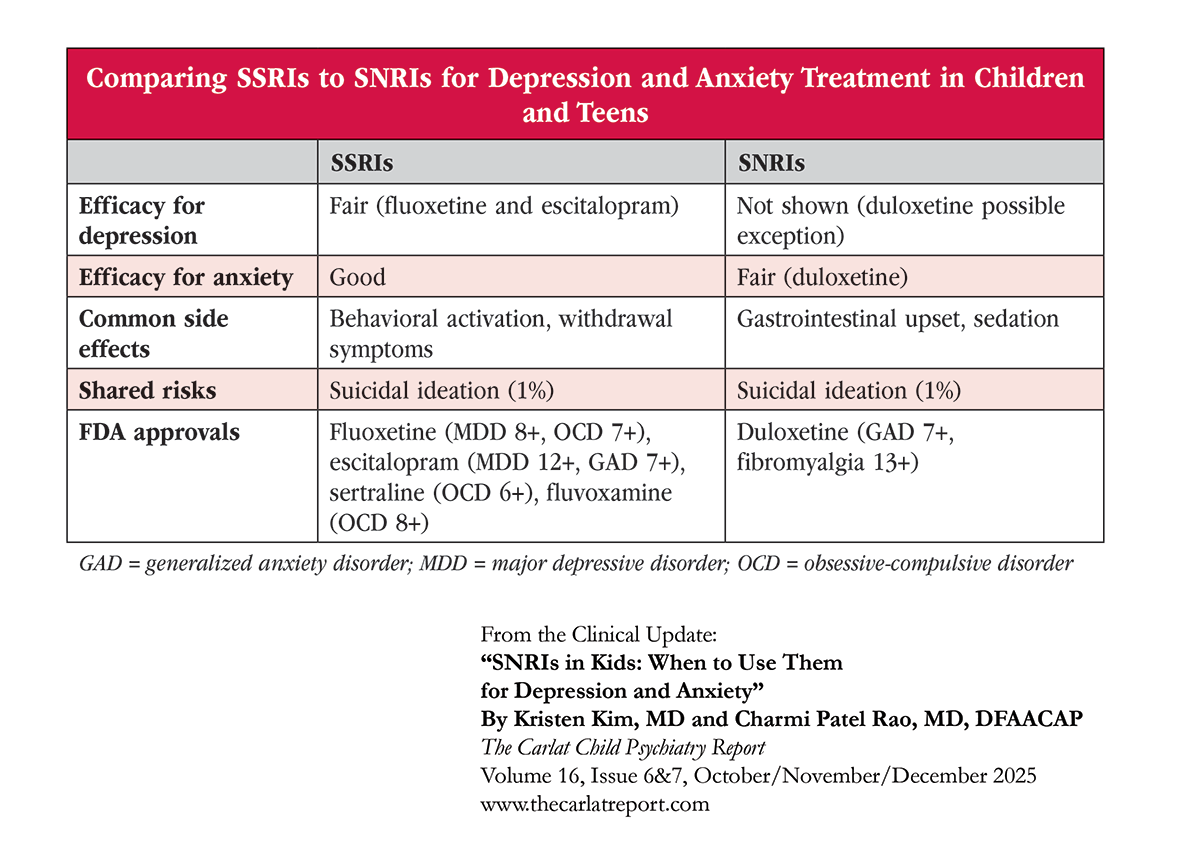
For more, see the table above “Comparing SSRIs to SNRIs for Depression and Anxiety Treatment in Children and Teens.”
Unless Anna has already tried SSRIs without benefit or with significant adverse side effects, starting with an SSRI is the best call. You let her mother know that while duloxetine can help some kids with anxiety, it is not as consistently effective as SSRIs for depression.
Carlat Verdict: For youth with depression or anxiety, start with therapy when possible and stick with SSRIs for your first two medication trials. Reserve duloxetine—and occasionally other SNRIs—for cases where SSRIs don’t work or aren’t tolerated, or when comorbid anxiety or pain tips the balance.



Recommended