
_-The-Breakthrough-Antipsychotic-That-Could-Change-Everything.webp?t=1729528747 "KarXT (Cobenfy)_ The Breakthrough Antipsychotic That Could Change Everything.jpg")
Clinical Update
Managing the Side Effects of Lithium
Getting your Trinity Audio player ready...
Why element number three on the periodic table helps mania and treatment-resistant depression is not entirely understood. How it frightens off both patients and prescribers, however, is obvious: Kidney damage. Diabetes insipidus. Thyroid problems. Memory lapses. Weight gain. Tremor. Nausea. This gamut of potential miseries often keeps lithium from being both prescribed and taken (Rybakowski J, Front Mol Neurosci 2018;11:349; Grandjean EM and Aubry JM, CNS Drugs 2009;23(5):397–418). However, most of these obstacles are manageable, clearing the path to lithium’s unique benefits.
Indications and initiation
As a monotherapy in bipolar I, lithium has demonstrated superiority to valproate, lamotrigine, olanzapine, and quetiapine (Rybakowski, 2018). Unlike the antipsychotics, it can prevent unipolar depression, and it lowers suicidality in both unipolar and bipolar disorders. Despite its medical risks, lithium lowers medical mortality in bipolar disorder. It protects DNA from aging, and has neurotrophic and neuroprotective properties. It may even fend off cognitive decline and dementia (Post RM, Neuropsychopharmacology 2018;43(5):1174–1179; Chen PH et al, Acta Psychiatr Scand 2023;147(3):234–247). To top it off, lithium is inexpensive and widely available as a generic.
Lithium is effective for both bipolar I and II disorders. It tends to work best in patients with a classic course—those who experience euphoric manias or hypomanias followed by depressions, with extended periods of euthymia in between. Poorer response is more common in those with dysphoric or mixed episodes, comorbid anxiety, substance use disorders, or personality disorders, as well as those who rarely experience full recovery between episodes. These patients can still benefit from lithium, but are less likely to respond well.
Screening
Before starting lithium, check thyroid-stimulating hormone (TSH), calcium, and creatinine, as well as human chorionic gonadotropin (HCG) in women of childbearing age. Lithium can be continued in pregnancy if necessary, but it carries a risk of congenital abnormalities, around 1 in 38, particularly cardiac abnormalities (Fornaro M et al, Am J Psychiatry 2020;177(1):76–92). For patients over 50, or who have risk factors for coronary artery disease, order an ECG. Lithium does not prolong the QT interval, but it rarely causes repolarization abnormalities (eg, T wave abnormalities, sinus dysfunction, AV and bundle branch block).
Lithium levels
Lithium’s therapeutic range depends on the clinical target. For bipolar maintenance, bipolar depression, and unipolar depression, aim for a level of 0.6–0.8 mEq/L. But when treating acute mania, you’ll need to go higher—think “let mania take you higher” as a mnemonic—to a range of 0.7–1.2 mEq/L. Older patients have more porous blood-brain barriers and generally require levels 30% below those. Draw lithium troughs about 12 hours after the last dose and no sooner than 5 days after the last dose change. Although dosing lithium entirely at night may artificially raise the level, the effect is slight, and experts do not recommend changing the target range because of it. Check levels once or twice a year, or more often if patients are older, unstable, or have drug interactions.
- Common interactions that raise lithium include nonsteroidal anti-inflammatory drugs (NSAIDs), a few antibiotics, and several antihypertensives:
- Angiotensin-converting enzyme (ACE) inhibitors: the “-prils” (benazepril, captopril, enalapril, lisinopril)
- Angiotensin II antagonists: the “-sartans” (azilsartan, losartan, valsartan)
- Antibiotics: levofloxacin, metronidazole
- NSAIDs: celecoxib, diclofenac, etodolac, ibuprofen, indomethacin, meloxicam, nabumetone, naproxen, piroxicam, tolmetin
- Thiazides: chlorothiazide, chlorthalidone, hydrochlorothiazide
Among the NSAIDs, sulindac has the lowest risk of interacting with lithium. Instruct patients to stick to aspirin or acetaminophen if they need an over-the-counter painkiller, and to stay well hydrated, especially when the weather gets hot or they are exercising. Lithium toxicity can be acute or build up over time, progressing from nausea, vomiting, and diarrhea to confusion and ataxia, and finally seizures and encephalopathy. Treatment starts with emergency department evaluation and ranges from hydration to dialysis.
Side effects
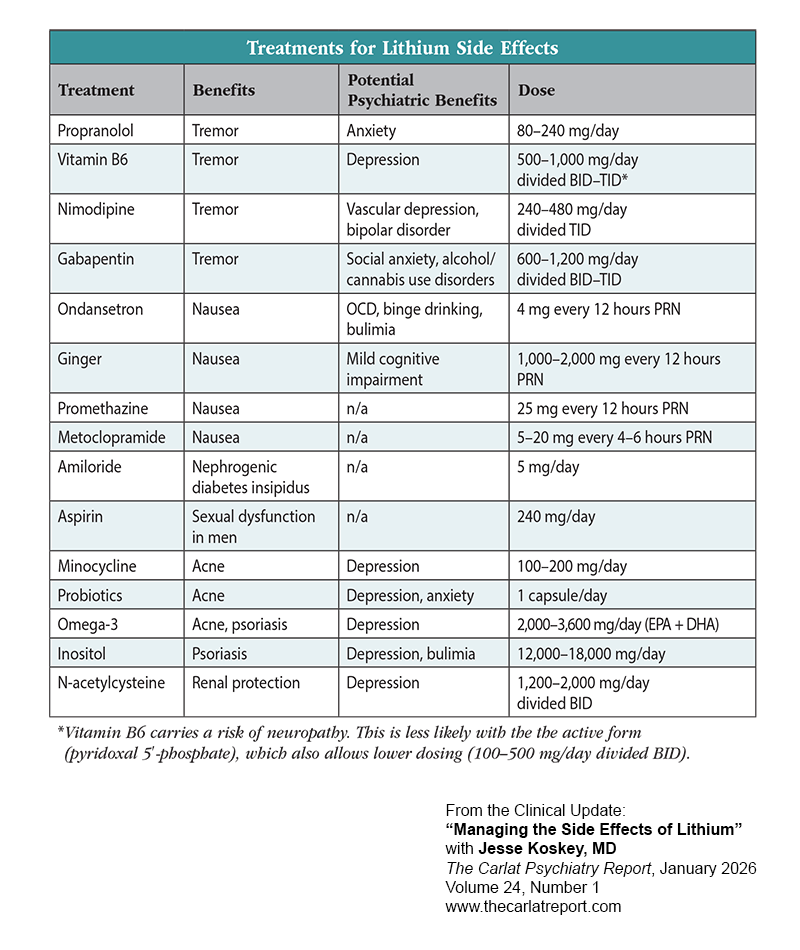
Most lithium side effects improve by dosing it all at night and using an extended-release formulation. Diarrhea is one exception, which improves with instant-release lithium (see the table “Treatments for Lithium Side Effects” on page 3).
Weight, sedation, and cognition
First, the good news. After lamotrigine, lithium carries the lowest risk of weight gain and sedation amongst bipolar meds. Several meta-analyses have found no significant short- or long-term weight gain with lithium (Gomes-da-Costa S et al, Neurosci Biobehav Rev 2022;134:104266). Advise patients that lithium may make them thirsty, and they can reduce weight gain by sticking with water and avoiding diet sodas or caloric beverages. The risk of sedation is also low (1 in 28).
Over the long term, lithium tends to preserve cognition better than antipsychotics. However, some patients do experience cognitive slowing, particularly at higher serum levels.
Gastrointestinal
Nausea is a common early side effect of lithium, and while it often improves over time, it can be a dealbreaker if not addressed promptly. Early intervention with antiemetics is key. Ondansetron is preferable, as it avoids the tardive dyskinesia risk of dopamine antagonists like promethazine and metoclopramide. For patients hesitant to add another prescription, ginger capsules are effective for nausea and share a similar mechanism as ondansetron, blocking serotonin 5-HT3 receptors. To further minimize nausea, advise patients to take the antiemetic 30–90 minutes before dinner and to take lithium after dinner.
Renal
Increased thirst and urination are common with lithium and can range from a minor nuisance to nephrogenic diabetes insipidus (NDI), a condition where the kidneys become unresponsive to antidiuretic hormone. NDI can lead to dehydration, hypernatremia, and electrolyte disturbances, plus it may contribute to chronic kidney disease (CKD). The risk increases when lithium is combined with selective serotonin reuptake inhibitors (Malhi GS and Tanious M, CNS Drugs 2011;25(4):289–298). Management should be coordinated with the patient’s PCP. First-line treatment for NDI is amiloride, 5 mg/day.
Renal function declines with long-term lithium use, but the risk is difficult to quantify because bipolar disorder itself can also impair kidney function. Newer studies suggest the risk to the kidneys is minimized by keeping lithium levels below 0.8 mEq/L and dosing it entirely at night (Clos S et al, Lancet Psychiatry 2015;2:1075–1083). Refer to a nephrologist if the estimated glomerular filtration rate falls below 60, but don’t reflexively stop lithium. Abrupt cessation can cause rebound mood symptoms, and switching to other mood stabilizers may accelerate renal decline (Markowitz GS et al, J Am Soc Nephrol 2000;11(8):1439–1448).
The antioxidant N-acetylcysteine (NAC) may further protect the kidneys. It did so in animal studies of lithium toxicity and in human studies of CKD (Hernández-Cruz EY et al, Kidney Int Rep 2024;9(10):2883–2903). NAC can also reduce chronic, low-grade depression in bipolar disorder.
Endocrine
The thyroid and parathyroids are the other organs that need regular monitoring during lithium therapy. Hypothyroidism occurs in 10%–20% of long-term users, but it’s rarely a reason to stop the medication. Treat hypothyroidism with levothyroxine (T4), as even mild elevations of TSH are associated with greater depressive relapse (Frye MA et al, Acta Psychiatr Scand 2009;120:10–13). For complex thyroid problems, refer to an endocrinologist.
Hyperparathyroidism is less common (4%) and is screened by checking serum calcium. If calcium is elevated, check the parathyroid hormone (PTH); if PTH is also high, refer to an endocrinologist. Patients with hyperparathyroidism may complain of fatigue or brain fog, but most cases are asymptomatic. Untreated, however, it can cause osteoporosis and renal stones.
Neurological
Lithium can cause a low-grade, highfrequency tremor that usually improves with a lower dose (and lower caffeine intake). Several treatments are available. The best evidence is with propranolol and vitamin B6. Antipsychotics often worsen the tremor, and lithium in turn can worsen extrapyramidal side effects from antipsychotics (this interaction is sometimes labeled “neurotoxicity,” although it doesn’t reflect actual neuronal damage).
Rarely, lithium causes taste changes or muscle weakness. Extremely rare is pseudotumor cerebri, aka idiopathic intracranial hypertension. This presents with headaches, papilledema, and vision loss and is best managed by a neurologist.
Skin and hair
Lithium’s dermatologic side effects include acne, psoriasis, and thinning or coarsening of the hair. These are rare and best managed by a dermatologist—particularly psoriasis, which may require lithium discontinuation. The treatment for hair loss on lithium is unknown, though minoxidil may help (as prescription or over the counter). Some psoriasis treatments, such as inositol and omega-3 fatty acids, also improve depression.
TCPR Verdict: Consider lithium for long-term prevention in depression and bipolar disorder, especially those with classic, euphoric (hypo)manias that are followed by depression. Although the side effect list is long, most are manageable, and they are balanced by lithium’s ability to reduce suicidality and all-cause mortality in bipolar disorder.


Recommended