Expert Q&A
Autism and Divorce: A Legal Expert’s Guide for Clinicians
Getting your Trinity Audio player ready...
CCPR: How are child custody disputes in families with autistic children different from child custody disputes where the children are neurotypical?
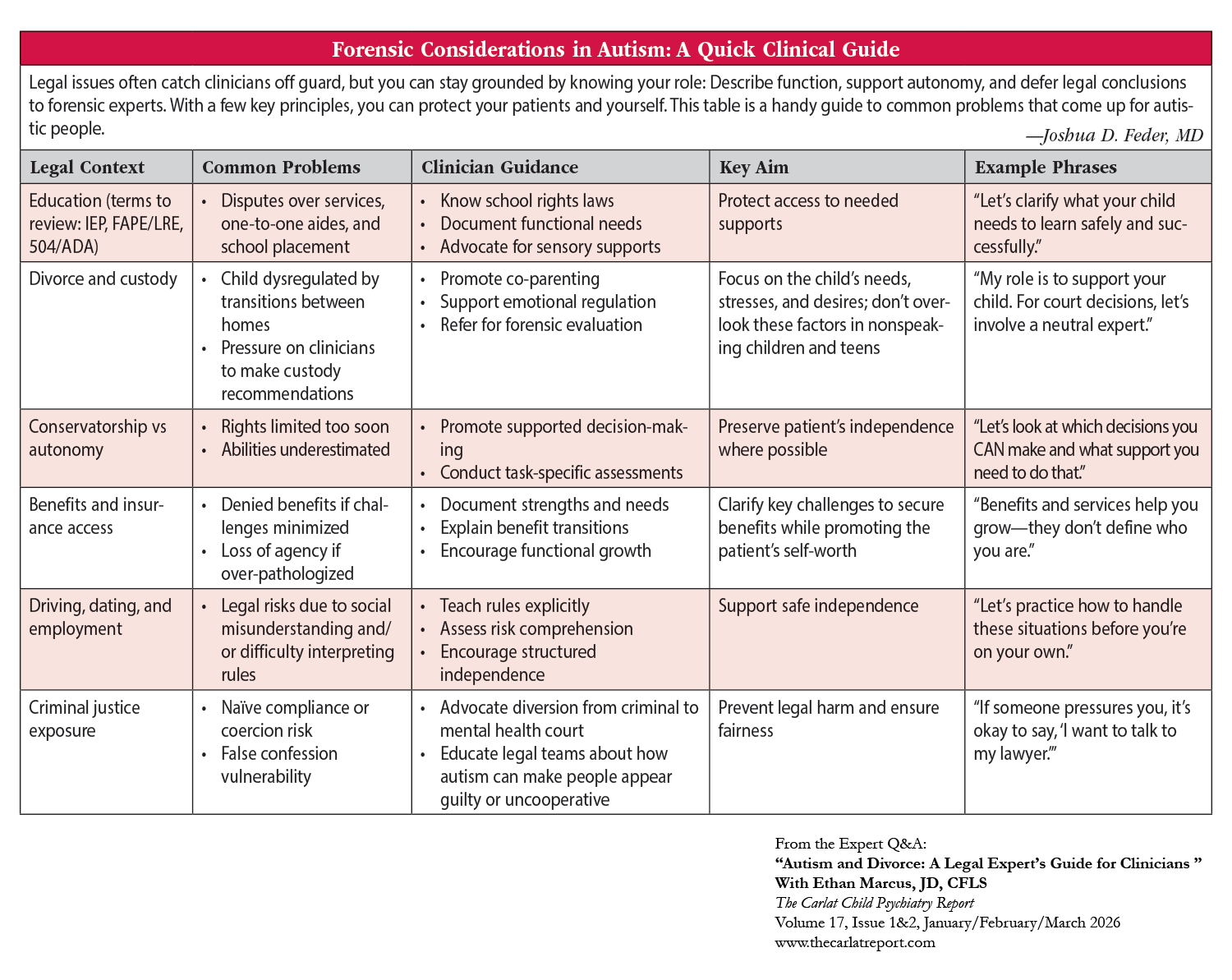
Mr. Marcus: Autism can present with problems like severe dysregulation, absence of spoken communication, and—even in more regulated and verbal kids—social challenges like misunderstandings and bullying. This can make child custody proceedings more complicated than those involving neurotypical kids, since child custody disputes in families with autistic children often center around disagreement about the child’s care. Parents (meaning persons with parental rights, authority, and responsibility, regardless of biology) may have conflicting ideas about therapies, education, or even diagnosis. These disagreements can escalate into court battles where judges, who are not medical professionals, are asked to make clinical decisions. That’s where clinicians become essential. Courts rely on clinical expertise to identify which parent can best make informed medical and developmental decisions.
CCPR: So, clinicians tell the court which parent should be in charge?
Mr. Marcus: The court makes that decision, but clinicians can have important input, and the court might note which parent more actively seeks professional advice. When parents share authority but disagree, the court may need to designate the parent who presents as better informed and better motivated to make medical decisions rather than leave in place a paradigm where disagreement translates into inaction (eg, one parent might veto or otherwise impede necessary services). Over time, the out-parent can learn that renewed participation or shared authority can depend on accepting the child’s needs as they really are and on becoming a positive part of the child’s support team. Clinicians can accelerate this process, building trust by maintaining communication, focusing on data, and emphasizing the child’s developmental and emotional needs. Generally, autism specialists on both sides of a custody dispute recommend comprehensive, evidence-based care, and courts are usually persuaded by this consensus. While one parent might not understand the need for sensory-motor occupational therapy for an autistic child, when experts hired by attorneys for both sides align (which is common) and the legal system is guided by that expertise, the parent can learn to get on board.
CCPR: Some disputing parents of autistic kids try mediation. Is the clinician’s role different there?
Mr. Marcus: Mediators are not decision-makers. Their only role is to facilitate communication between disputing parents. As such, the conversation can devolve into horse-trading over “fairness” or financial considerations. In California, child support is based on the time the parent has with the child, creating a strong financial motive for demanding equal time regardless of the impact on the child’s development. Since autism care is expensive, further financial pressures can distort priorities. For mediation to be successful, the discussion must start with reaching agreement on the child’s actual needs, and only afterward should the parents talk about their respective roles in meeting those needs. Just like in court, the role of clinicians in a mediation setting would be to give their best professional advice to the parents (and the mediator, if invited) and focus on child-centered planning. Parents and mediators could be advised that splitting time equally might not be in the best interest of many autistic children, who need a more stable home base and routine. When clinicians provide concrete descriptions of the child’s functioning, tolerance for transitions, and therapy requirements, their decisions are grounded in evidence. Expert input ensures the child’s needs aren’t lost in parental conflict.
CCPR: How does a clinician help the process, whether in court or in mediation?
Mr. Marcus: An autistic child’s clinician helps the court understand that child’s developmental or clinical needs. Testimony might include observations about the child (eg, the child’s ability to indicate their distress, even when they are nonspeaking). The clinician can also give treatment recommendations, such as using a communication device at both homes and getting support for parents to use it more effectively. They can also talk about treatments they are currently conducting, like relationship-based approaches (which can reduce concerns about parental alienation). Clinicians might also talk about the level of cooperation of each parent.
CCPR: Do courts ever put the clinician in charge of decision-making?
Mr. Marcus: Courts sometimes try to assign authority to a treating provider—ordering, for example, that “the parents will follow the clinician’s recommendations.” That is inappropriate, and clinicians should decline such roles and remind the court that parents must make decisions. Clinicians should also reiterate that parents will need the best information they can get, often several opinions, since no one clinician can see the entire picture. Clinicians should remind the court that clinical care involves trial and error and may require different clinicians with different skills. It’s not black and white, which is an absolute surprise to parents, lawyers, and courts.
CCPR: How should clinicians respond if they receive a subpoena for records or testimony for an autistic child?
Mr. Marcus: Consult your own attorney. These are legal questions that neither parent’s attorney should answer for you. Subpoenas raise issues of confidentiality and ethics that vary by jurisdiction. Your attorney can determine how to respond appropriately and whether to seek a protective order to prevent inappropriate disclosure of information. Make sure your service agreements with the parent or parents allow billing for your time spent responding to subpoenas, consulting with attorneys, or testifying. All of this is part of your professional role for which you need to be reimbursed.
CCPR: What if a clinician receives a court order to conduct an evaluation?
Mr. Marcus: It’s your decision whether to do it. Clinicians cannot be compelled to provide services. The 13th Amendment protects all of us from involuntary labor. Get legal advice. You might communicate with the court: “Thank you for thinking of me, but that’s outside of what I can ethically do, and here are the limits and the scope of what I can and am willing to do.”
CCPR: Do you think a treating clinician should ever serve as an expert witness in cases involving autistic children?
Mr. Marcus: It’s complicated. I prefer when treating clinicians serve as experts, because they know the child better than non-treating experts. That said, many clinicians feel they cannot provide an objective opinion in court while also serving as the child’s clinician—especially in complex cases involving traits such as autism, where there might be disagreement among respective parents and providers about goals (eg, whether to prioritize “normalizing” behaviors versus accepting the child’s differences and building on the child’s strengths). While treating clinicians’ clinical observations are invaluable, a parent might fear alienating them by putting them on the stand. Another parent might feel a clinician who is hired by the other side will favor that other parent’s position rather than placing the child’s needs first. But so long as the clinician makes it clear that their role is to advocate for the best interests of the child, that concern can be mitigated. (Editor’s note: CCPR aligns with the American Academy of Psychiatry and the Law (AAPL), which explicitly recommends not to mix expert witness and clinical roles, as this will likely both compromise one’s objectivity in finding truth for the court and harm the treatment relationship with the patient. For more information, see the AAPL Ethical Guidelines for the Practice of Forensic Psychiatry (adopted May 2005): https://aapl.org/ethics-guidelines/)
CCPR: How can we work with parents of autistic kids who are themselves very fixed in their ideas about child custody disputes?
Mr. Marcus: A very gifted clinician shared with me that some of an autistic child’s traits—rigidity, persistence, difficulty with transitions—might reflect shared neurobiological patterns with the child’s parents, and I have tried gently to communicate this perspective with parents. With kindness and love, we can talk about valuing a parent’s own traits and the challenges such traits might bring. Reframing these similarities helps parents feel understood rather than judged. Clinicians can validate their strengths: “Your persistence has helped your child get services,” while gently challenging the rigidity that interferes with collaboration: “I think you can be an even better advocate if you consider the care plan from the other perspectives.” As a lawyer, I find it difficult to reference this rigidity in court or in any other context unless it’s coming from the mouth of an expert witness, because it can sound like I’m labeling and dismissing a parent for having an autistic trait. It is beneficial to have a clinician use the therapeutic frame: “Let’s focus on what your child needs to thrive across both homes.” Even if the personal relationship of the parents ends, they remain co-parents. Getting through that transition can involve years of war before we get to that point, but that’s the goal.
“I call court a ‘university of one,’ where the judge is the student. We bring professors to teach the student so that this student can decide on an important question. So don’t be afraid of court. Instead, bring the joy and excitement that you bring to your field and share with clients and at conferences.”
Ethan Marcus, JD, CFLS
CCPR: What approaches help parents of autistic kids see the facts more clearly?
Mr. Marcus: Address emotional needs. Parents in these high-conflict child custody disputes often feel anxious or invalidated. Unless those emotions are acknowledged, the parents can’t absorb new information. Listen to the parents before advising. If you can’t meet them where they are, they’re not going to hear you. Establish communication patterns (eg, asking each individual to thank the other person for raising a topic before explaining why a different conclusion might be reached). Hear the parent’s point, even if the point is not supported by data, because it gives data about the parent’s perspective. I’ll give you an example: One parent might oppose vaccinations while the other might favor them. People opposed to vaccines have often heard frightening reports of autistic regression, and parents who favor vaccines are generally aware of the impacts of the infections that vaccines can prevent. Counsel both parents to get as much information as they can from a range of sources, opening them to the possibility of accepting other data. This might lead them to a consensus or better acceptance of the decision of a parent who has the deciding authority.
CCPR: Can you talk about the challenges of getting good data regarding how an autistic child is doing?
Mr. Marcus: Data gaps are common. If one parent resists services, in-home data may be incomplete. School staff may avoid detailed reporting to stay clear of custody disputes. They may provide general reports with no specific dates or details. Schools have other motivations too, such as budgetary concerns and political dynamics. Clinicians should explain these limitations when reporting to the court and clarify that data collection depends on parental cooperation and school engagement.
CCPR: What should clinicians consider when parents disagree about autism interventions, such as applied behavioral analysis (ABA) versus developmental relationship–based models (DRBI)?
Mr. Marcus: Disagreements about therapy are common. The more-involved parent may seek to move away from traditional ABA and toward DRBI or other relationship-based approaches when ABA is not effective or causes stress. ABA remains widespread and well funded, but evidence increasingly supports individualized, relationship-focused care (Editor’s note: See our interview with Dr. Micheal Sandbank in CCPR April/May/June 2021 for further discussion of data concerns with traditional ABA). In all settings—court, mediation, or other negotiations—clinicians should explain how each model addresses the child’s goals, regulation, and safety. It’s basically like informed consent. Present objective data from sessions, note the child’s progress or distress, and recommend that both parents observe sessions whenever possible.
CCPR: Any final thoughts?
Mr. Marcus: Courts don’t have supernatural powers. Clinicians are often surprised at how little judges and attorneys know about how serious autism and kids’ special needs can be. I call court a “university of one,” where the judge is the student. We bring professors to teach the student so that this student can decide on an important question. Don’t be afraid of court. Instead, bring the joy and excitement that you bring to your field and share with clients and at conferences. Your presentation will be guided by the rules of court, but it is interesting, important, and helpful information if the right people hear you and understand you.
CCPR: Thank you for your time, Mr. Marcus.




Recommended