Expert Q&A
Beyond Meds: TMS in Acute Psychiatric Care
Getting your Trinity Audio player ready...
CHPR: Dr. Trapp, please start with a quick overview of transcranial magnetic stimulation (TMS).
Dr. Trapp: Sure. TMS is a form of noninvasive brain stimulation that allows us to activate different regions of the brain. It’s pretty much what the name suggests—“transcranial” meaning it goes across the skull and into the brain without surgery, and “magnetic” in that it uses pulsed electromagnetic energy to influence brain activity. When these magnetic pulses hit the brain repeatedly, the neurons respond by generating electrical signals. So, in a way, we’re tapping into the brain’s natural electrical system to modulate activity using an external device. Depending on the size of coil used, we can target areas as small as a quarter or much larger regions. TMS is most commonly used to treat depression, but it’s also FDA cleared for OCD, migraine headaches, smoking cessation, and major depressive disorder with anxious distress.
CHPR: Who qualifies for TMS, and has that changed over time?
Dr. Trapp: That’s evolved a lot. TMS was first FDA cleared in 2008 for adults with major depressive disorder who had failed just one antidepressant. The clearance was pretty narrowly defined. Since then, FDA labeling has broadened to include more treatment-resistant forms of depression. In practice, insurance companies often require patients to fail several medications before covering TMS. TMS can be used alongside medications or on its own, and it is also being explored for maintenance. So, it’s become more flexible and accessible.
CHPR: How does TMS translate to the inpatient setting? Would patients with treatment-resistant depression be the best candidates?
Dr. Trapp: Yes, exactly. That’s been the most common indication. What’s neat about TMS is that it’s really just a tool for interacting with the brain. You can use it diagnostically with single pulses to test circuits, like stimulating the motor cortex to see motor-evoked potentials in the hand. But when we apply repetitive stimulation, we can modulate brain activity for therapeutic purposes. The most reliable antidepressant effects come from targeting the left prefrontal cortex.
CHPR: How does the response to TMS compare to antidepressants or ECT?
Dr. Trapp: That’s still being actively studied. There aren’t many large head-to-head trials, but one important study—the ASCERTAIN-TRD trial—looked at depressed patients who had failed medication to compare the benefits of switching to a new antidepressant, augmenting with aripiprazole, or starting TMS (Papakostas GI et al, Mol Psychiatry 2024;29(8):2287–2295). TMS outperformed switching meds and did about as well, maybe slightly better, than augmentation. So, in many clinicians’ minds, TMS is moving up the treatment algorithm, especially for people with treatment-resistant depression.
CHPR: Are you seeing TMS used more on inpatient units?
Dr. Trapp: Honestly, it’s still tough to pull off. Insurance coverage and logistics are big hurdles. We’ve done it in some cases using the standard outpatient protocol of one session per day. But the response is slow—it often takes two to four weeks or more—so we might start TMS in the hospital and finish it outpatient. That could all change with accelerated protocols. The best known is Stanford’s SAINT protocol: 10 short sessions a day for 5 days (Cole EJ et al, Am J Psychiatry 2020;177(8):716–726). The median time to response was two or three days. But logistics are still challenging. Do you bring a TMS machine onto the unit for occasional use? Do you escort patients off the ward multiple times a day for treatment? How do you work TMS around inpatient unit activities such as group therapy, meals, rounds, and medication administrations? Any solution requires close coordination and scheduling with nursing and other inpatient teams. So while interest is growing, inpatient TMS isn’t routine yet.
CHPR: And how long is a typical TMS treatment course, aside from the accelerated protocols?
Dr. Trapp: Standard TMS is five sessions a week for six to seven weeks. Some programs taper at the end. SAINT condenses 50 sessions into 5 days. We’re seeing exploration of even more compact options, like 20 sessions in a single day, but those data are not published in a peer-reviewed form yet. Some patients prefer the gradual approach, taking just a bit of time each day; others want to get it done fast, especially if they’re from out of town or very ill. So far, the safety profile looks similar across protocols.
CHPR: How long is each individual session?
Dr. Trapp: With the theta burst protocol, which is the fastest one, a session takes about three minutes. The SAINT protocol uses a modified version that takes about 10 minutes per session. Older protocols can take 20–40 minutes.
CHPR: What side effects should we be aware of, especially with accelerated protocols?
Dr. Trapp: TMS is generally well tolerated. The main side effects are headache and scalp discomfort. Some people get jaw pain if facial muscles are activated. Lightheadedness or, rarely, fainting can occur. The most serious risk is seizure, but it’s extremely rare. For most patients, the risk is estimated to be about 1 in 30,000. It may be higher in higher-risk populations, like patients with underlying seizure disorders or other risk factors, but it’s still very rare, maybe 1% incidence. Risk factors include things like seizure disorders, moderate or severe traumatic brain injury, alcohol withdrawal, or severe sleep deprivation. But with proper precautions, it’s very safe.
“People who’ve had bad experiences with meds often like the idea of a noninvasive option. Some are nervous at first. They’ll ask questions such as “Will it change my personality?” or “Is it going to mess with my brain?” But usually once they see how it works, try it out, or talk to someone who has had treatment, they feel reassured.”
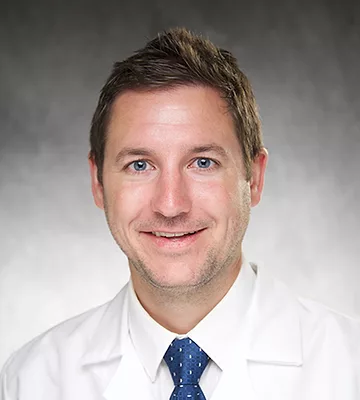
Nicholas Trapp, MD, MS
CHPR: So aside from patients at risk for seizures, are there other groups we should be especially cautious with?
Dr. Trapp: Even seizure disorders aren’t an absolute contraindication. You can still do TMS safely in some of those patients, but you have to take appropriate precautions. The biggest absolute contraindication is having ferromagnetic material in the head or neck, because TMS induces a powerful magnetic field, about the strength of a 1.5 Tesla MRI. It can deactivate your badge or your credit card if you hold it too close to the coil. And if there’s magnetic material inside the body, the magnet can pull it, push it, or even heat it up, which is obviously dangerous. That said, most modern surgical implants are non-ferromagnetic, like titanium. But cochlear implants are a concern because they have coiled wires that could interact with the magnetic field. A 2021 study in Journal of Clinical Neurophysiology showed that anything within 10 centimeters of the coil could be at risk, but beyond that is usually fine (Rossi S et al, Clinical Neurophysiology 2021;132(1):269–306). If someone has a pacemaker or deep brain stimulator, we always consult with the device manufacturer or surgeon.
CHPR: Can TMS induce mania?
Dr. Trapp: Yes, but it’s rare. When it happens, it’s usually in people with undiagnosed bipolar disorder. Some people don’t realize they have bipolar disorder until they have a manic episode during treatment. The rate of spontaneous mania in the general population is similar to that induced by TMS, but it’s something we monitor closely. If it occurs, we usually stop treatment.
CHPR: You mentioned earlier that the coil size can vary. Is there a reason to use different-sized coils?
Dr. Trapp: Yes. Some coils are designed to stimulate a broad area, and others are more focused and precise. Coils with broader and deeper electric fields may help ensure we don’t “miss the target,” but they also lack the precision to focally stimulate specific brain networks. We still don’t know how important it is to be focal and precise with our stimulation, and there’s still debate about the best targeting strategy. However, both “deep” TMS coils and more superficial and focal coils seem to be effective at inducing an antidepressant effect.
CHPR: And how receptive are patients to TMS?
Dr. Trapp: I’d say they are very receptive overall. TMS doesn’t have systemic side effects and doesn’t involve medications or implants. People who’ve had bad experiences with meds often like the idea of a noninvasive option. Some are nervous at first. They’ll ask questions such as “Will it change my personality?” or “Is it going to mess with my brain?” But usually once they see how it works, try it out, or talk to someone who has had treatment, they feel reassured.
CHPR: And what about relapse rates once they’ve completed the course of treatment?
Dr. Trapp: That’s one of the big challenges. There’s no FDA-cleared maintenance protocol yet, so most people do an acute course and then wait and see how long benefits last. About 50% relapse within a year. Some need another course at 6 or 12 months (Senova S et al, Brain Stimul 2019;12(1):119–128). This suggests potentially greater durability with TMS compared to something like ECT, assuming no maintenance is available for either. However, with maintenance treatment, relapse rates drop significantly for ECT, and you would imagine the same holds true for TMS. This needs to be studied in more detail. The good news is that if TMS worked for someone once, their chances of responding again are high—around 80% (Kelly MS et al, J Neuropsychiatry Clin Neurosci 2017;29(2):179–182). We do talk about maintenance TMS with some patients, but there’s no agreed-upon frequency yet. Weekly? Monthly? We need more data. Most insurers don’t cover maintenance TMS, and we’re forced to wait until symptoms return to consider another treatment course.
CHPR: Do you try to taper off benzodiazepines, like we often do with ECT?
Dr. Trapp: Not typically. Some retrospective data suggest benzodiazepines might blunt TMS response, so some providers use that as a reason to taper or stop them. And while we don’t have strong prospective data yet to prove that, there’s also a solid theoretical rationale. If TMS works by enhancing neuroplasticity, increasing synaptic density, or modulating cortical excitability, benzodiazepines can potentially dampen all of those mechanisms. So, in practice, we do talk to patients about it, especially if they’re not responding as well as expected or if reducing benzodiazepines is a good idea for other reasons. In those cases, we might suggest trying to taper down or discontinue the benzodiazepine, if it’s safe and appropriate. But again, we need more data to definitively support those management decisions.
CHPR: Are there patient populations who respond better than others to TMS?
Dr. Trapp: People with long-standing or severe treatment resistance are less likely to respond. TMS studies in adolescents have been mixed, but it is FDA cleared down to age 15. Geriatric patients seem to respond about as well as younger adults (Bacila CI et al, J Clin Med 2025;14(10):3609). TMS is currently FDA cleared up to age 86 as well, and probably only up to that age because of limited sample sizes at higher ages.
CHPR: TMS would seem like a good choice for geriatric patients since they are more susceptible to medication side effects and drug interactions.
Dr. Trapp: Yes, absolutely.
CHPR: Now that we have a better idea of which patients can benefit most from TMS, can you tell us more about the logistics involved in starting it?
Dr. Trapp: For the SAINT protocol, you need access to a functional MRI (fMRI) scanner. So first, the patient needs to get the fMRI scan, which is then uploaded to the cloud. Magnus Medical—the company that commercialized the SAINT protocol and owns the patent on the software—processes that scan and sends back a personalized target based on the individual’s brain activity. Once we have that target, we use neuronavigation equipment to deliver TMS precisely to that spot. With standard TMS, we usually rely on a scalp-based targeting method, which is simpler and cheaper but less personalized. Whether the fMRI-guided targeting actually improves outcomes is still being studied, but early data are promising. If it turns out to make a big difference, that’s great—we’ll have a more precise, imaging-based way to deliver treatment. But if it doesn’t add much, it may just be slowing things down and adding complexity and cost without significant benefit. Access to an MRI scanner capable of doing resting-state functional imaging often means involving radiology departments with the right expertise, so it’s not something every hospital can do yet.
CHPR: There’s more to it than I’d realized.
Dr. Trapp: Definitely. Another key piece is the financial logistics. The SAINT protocol is the first TMS protocol to receive a “new technology add-on payment” designation for inpatient use, which helps cover the extra resources needed. But here’s a wrinkle: This designation comes from the Centers for Medicare and Medicaid Services, and it only applies to inpatient units that are classified as part of a general medical facility. There’s now active advocacy underway to change this, because it severely limits access to the protocol outside of select hospitals. And it highlights a bigger issue in psychiatry—we don’t have many treatments, besides ECT, that involve this level of technological complexity and coordination. Administering such treatments requires a reimbursement and practice infrastructure that goes beyond meds or therapy, and changing medical practice in such a radical way can be very difficult. So figuring out how to navigate reimbursement and logistics is a key part of making TMS and other device-based treatments more widely available.
CHPR: Is there anything else we should know about TMS?
Dr. Trapp: Staffing and training is an overlooked piece. TMS is usually delivered by a technician who completes a certification program, who is supervised by a physician. This certification program is hospital based, not nationally standardized. It’s similar to how ECT staff are credentialed. Several people around the country, including myself, are working on developing training standards for clinicians and technicians. We’re also creating a credentialing process for brain stimulation fellowships, which would offer more formalized training paths for psychiatrists, neurologists, or neurosurgeons interested in this area to augment and expand upon their training. There’s a lot of new technology coming—not just TMS and ECT, but also focused ultrasound, transcranial electrical stimulation, new minimally invasive forms of brain stimulation, and more. Most of us didn’t learn much about these interventions in residency, though that’s starting to change. I think in the future, we’ll see more fellowship-trained brain stimulation specialists. It may not be required to deliver TMS, but especially for the newer, more advanced treatments, it’ll be a valuable path forward.
CHPR: Thank you for your time, Dr. Trapp.

Recommended