_-The-Breakthrough-Antipsychotic-That-Could-Change-Everything.webp?t=1729528747 "KarXT (Cobenfy)_ The Breakthrough Antipsychotic That Could Change Everything.jpg")
Expert Q&A
Clinical Pearls for Hyperbolic Tapering of Psychiatric Medications in Older Adults

Getting your Trinity Audio player ready...
CGPR: What are the most common clinician misconceptions about deprescribing psychiatric medications in older adults?
Dr. Horowitz: The most common misconception is that withdrawal symptoms are rare, mild, and brief. Withdrawal can occur across all major psychiatric drug classes, including antidepressants, antipsychotics, benzodiazepines (BZDs) and Z-drugs, gabapentinoids, and mood stabilizers; it can be severe and prolonged, particularly after long-term use. Another frequent misunderstanding is assuming that difficulty stopping a medication reflects psychological dependence, relapse, or poor motivation, rather than predictable neuroadaptation. Clinicians may therefore underestimate withdrawal risk or misattribute emerging symptoms. Finally, clinicians often assume that the smallest tablet equals a small effect. Pharmacodynamically, however, even tiny doses may exert substantial receptor-level effects, making the final steps of a taper disproportionately difficult to tolerate.
CGPR: What causes withdrawal neurobiologically?
Dr. Horowitz: Withdrawal reflects the brain’s drive for homeostasis. When a medication persistently alters neurotransmission, the central nervous system adapts with counter-regulatory changes, like altered receptor sensitivity and signaling shifts. After weeks to years of exposure, reducing or stopping the drug leaves this adapted system temporarily unbalanced, producing withdrawal symptoms. This process is known as physical dependence. It is a predictable neurobiological response to chronic drug exposure and occurs across many psychiatric medications.
CGPR: What are your core principles for tapering psychiatric medications in older adults?
Dr. Horowitz: First, slower is almost always safer. When the body has adapted to a certain level over time, changing that level too quickly can trigger symptoms. Second, tailor the taper speed to the individual: Pause, slow, or step back if symptoms escalate, then resume at a gentler rate. Third, use a hyperbolic taper: Make larger decrements early, then make progressively smaller decrements at the tail end. These principles apply to older adults, with added caution given physiologic vulnerability and altered pharmacokinetics and pharmacodynamics. Start conservatively, with 5%–10% monthly test reductions (which naturally become smaller as the total dose decreases), and adjust based on tolerability.
CGPR: What are the benefits of hyperbolic tapers?
Dr. Horowitz: Because many psychotropics have hyperbolic dose-response curves, linear reductions can produce disproportionately large effects at low doses. Hyperbolic tapers match dose reductions to receptor-level change, helping patients tolerate the final and often most difficult steps of discontinuation (Editor’s note: For more on the hyperbolic taper, see “How to Stop a Psychiatric Med” in TCPR Nov/Dec 2024).
CGPR: How long do successful hyperbolic tapers usually take in real-world practice?
Dr. Horowitz: Expect months to years, not weeks. In the clinic that I run in London where we deprescribe common psychotropics, excluding those for schizophrenia and bipolar disorder, the average time to discontinue is around 18 months. Long-term users of alprazolam, venlafaxine, and duloxetine rarely come off comfortably in under two years, whereas shorter-term users of fluoxetine or diazepam may complete a taper in a few months. In older adults, the overall trajectory is usually longer due to reduced physiologic reserve; “start low, go slow” applies to deprescribing too (Woodford HJ and Fisher J, Age Ageing 2019;48(6):768–775).
CGPR: In frail older adults, how do you balance withdrawal risk against the ongoing risks of continuing a medication?
Dr. Horowitz: Weigh the harms of staying on the drug, like falls, fractures, bleeding, metabolic effects, cognitive effects, and drug-drug interactions, against the harms of withdrawal if you taper too quickly. If there’s an urgent safety problem, prioritize dose reduction despite potential withdrawal symptoms; otherwise, prioritize tolerability to the withdrawal process by going slower. Avoid rushed tapers that trigger destabilization and abandonment of the plan. Often the safest path is a slow, feasible schedule that minimizes disruption while still reducing total exposure over time.
CGPR: What success rates can clinicians expect with patient-paced, hyperbolic tapers?
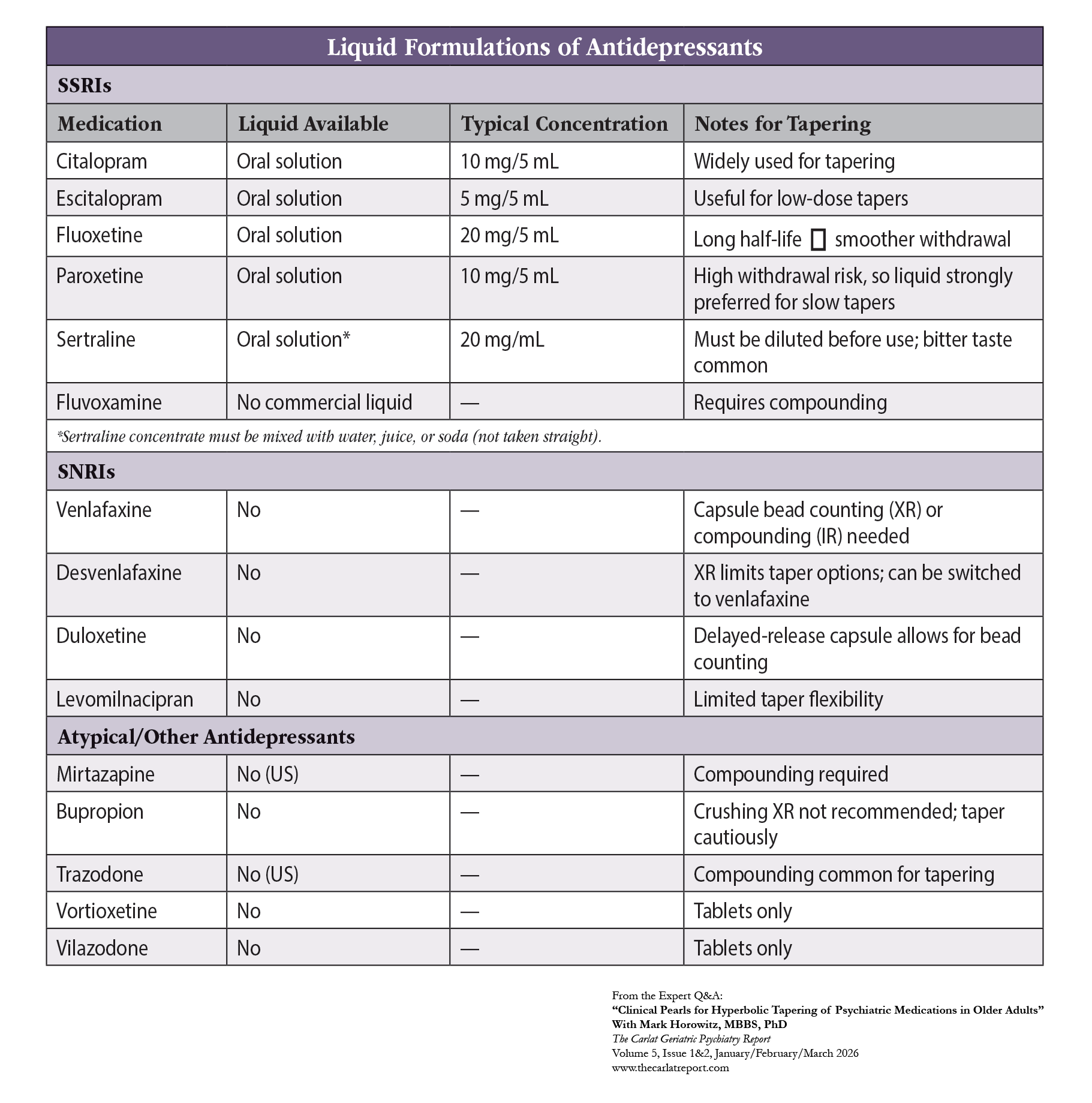
Dr. Horowitz: In our clinic, when patients choose to proceed with a gradual taper after the initial dose reduction, more than 90% ultimately complete discontinuation using individualized schedules that allow pauses or setbacks. Failure to complete is typically driven by life events or changing priorities, rather than an inability to taper below a specific physiologic dose. Success depends on moving at the patient’s pace and using liquid or compounded formulations when necessary.
CGPR: What nonpharmacologic supports help during a taper?
Dr. Horowitz: Lifestyle and psychotherapeutic strategies, like sleep hygiene, mindfulness, gentle activity, behavioral activation, and whole-foods nutrition, can take the edge off and support resilience. Social context matters as well. But the dominant modifiable determinant of success is taper speed: If symptoms emerge, slow further, pause, or take smaller steps. Don’t assume psychological optimization allows a rapid taper; even fit people get “the bends” if they ascend too quickly.
CGPR: How can we distinguish withdrawal from relapse of the underlying condition?
Dr. Horowitz: Keep withdrawal high on the differential. It’s common across medication classes and in long-term users. Clues include symptoms starting days to weeks after a dose reduction that differ from the patient’s baseline pattern (eg, panic or insomnia instead of lethargy and low mood). Physical signs like brain zaps, dizziness, and headaches support withdrawal. But the most common symptoms are psychological: anxiety, irritability, low mood, and panic. These symptoms often mimic relapse, which can be misleading. However, they may represent withdrawal rather than recurrence, since similar symptoms appear in people prescribed antidepressants for nonpsychiatric conditions (like menopause or pain) and even in healthy volunteers. When they stop the drugs, they develop the same symptoms. Clinically, one key question helps clarify the picture: What symptoms were present before starting the medication? New or different symptoms emerging after dose reduction, especially when they resolve quickly with reinstating a small dose (if performed soon after dose reductions), strongly suggest withdrawal rather than relapse.
“In older adults, begin at the slower end of suggested rates, expect to need decimals and syringes or compounds, and plan for more frequent monitoring and caregiver involvement for feedback on tolerability.”
Mark Horowitz, MBBS, PhD
CGPR: Can withdrawal start weeks after stopping? That seems counterintuitive to half-life math.
Dr. Horowitz: Yes. Delayed withdrawal is observed clinically. Some patients feel fine for weeks after stopping, then develop hallmark symptoms like brain zaps, dizziness, and panic. The mechanism is unclear, likely reflecting the time required for downstream processes to reach a threshold. Still, this pattern is well documented, and clinicians should not dismiss a late-emerging syndrome as unrelated. A practical take-home point is to maintain vigilance for new symptoms for several weeks or longer after dose reduction and consider a slower reattempt if delayed withdrawal appears.
CGPR: What withdrawal-related risks should clinicians monitor for?
Dr. Horowitz: Three stand out. First, suicidality can emerge during withdrawal, including passive or intrusive thoughts of death, even in patients without prior suicidal ideation. Monitor closely, slowing or pausing the taper if this occurs. Second, akathisia can emerge or worsen during withdrawal from antidepressants, antipsychotics, or BZDs. It’s often misdiagnosed as agitated depression or mania and requires urgent attention. Third, protracted withdrawal syndromes can last months to years; set expectations and proceed cautiously (Horowitz MA et al, Psychiatry Res 2025;350:116497). The best prevention is a slow taper. Avoid destabilizing people’s systems: An ounce of prevention is worth a pound of cure.
CGPR: How can clinicians achieve very small dose reductions at the tail end of a taper?
Dr. Horowitz: Use nonstandard formulations. Manufacturer liquids (when available) and pharmacy-compounded capsules, tablets, or liquids allow sub-tablet dose reductions that better match hyperbolic tapering. When access or cost is a barrier, off-label strategies can help. For capsule products like venlafaxine, bead counting is commonly used: The capsule is opened to remove a portion of the beads, and the remaining beads are taken, preferably in a capsule to prevent throat irritation. Other strategies include carefully crushing tablets with a spoon at the bottom of a glass or preparing simple oral dilutions by dissolving a known dose in a measured volume and removing incremental amounts. Select methods that match the patient’s vision, dexterity, and cognitive capacity, and involve caregivers when needed to ensure accuracy and safety. These approaches are not manufacturer-approved but can be safe when done meticulously with education and documentation. Although I practice in the UK, colleagues in the US use similar strategies; in my view, medicolegal concerns are often overstated relative to the clinical risks of abrupt discontinuation.
CGPR: For tapering off BZDs, do you recommend switching short half-life BZDs to diazepam before tapering?
Dr. Horowitz: Sometimes. Diazepam’s long half-life can smooth interdose withdrawal and may make reductions gentler for patients who experience between-dose crashes on short-acting agents like alprazolam. However, evidence for routine cross-tapering is mixed, so I reserve it for patients with clear interdose symptoms or poor tolerability. If you switch, do it gradually—converting to about 10% of the daily dose per week, then 20%, and so on—because individual equivalences vary and abrupt switches can destabilize. It’s also important to weigh risks in older adults, where BZDs with longer half-lives can increase adverse effects like sedation, cognitive impairment, and falls. For these reasons, in practice I usually taper patients on the BZDs they’re already taking, which minimizes variables and avoids the added time, complexity, and risk of switching.
CGPR: When tapering antidepressants, do you ever switch paroxetine or venlafaxine to fluoxetine to minimize withdrawal symptoms?
Dr. Horowitz: Generally, no. Antidepressant withdrawal is driven by adaptation to a variety of receptor targets, including serotonin, norepinephrine, acetylcholine, and others. Substituting fluoxetine does not reliably prevent withdrawal as it does not “cover” all the receptor targets of other drugs; symptoms may still emerge as the original drug is reduced. Fluoxetine is also not truly self-tapering. Its long-lived metabolite often delays withdrawal, so symptoms may appear weeks later and be missed with short follow-up. Over longer observation periods, withdrawal risk appears similar to other SSRIs. If fluoxetine is used as a bridge, it should itself be tapered slowly and hyperbolically.
CGPR: How do you handle interdose withdrawal without switching medications?
Dr. Horowitz: First, try smoothing plasma troughs by increasing dose frequency. For short-acting medications, splitting the daily dose into two to four doses can reduce interdose withdrawal and stabilize day-to-day symptoms, making subsequent tapering more tolerable without the complexities of cross-tapering and equivalence calculations. That said, this approach works best for highly adherent patients. Once dosing exceeds twice daily, missed doses become common and can worsen withdrawal. When adherence is a concern, consider strategies that automate consistency, such as timed pill organizers, phone alarms, blister packs, or caregiver-assisted dosing, before increasing dose frequency.
CGPR: How do you counsel patients and caregivers who resist deprescribing or fear prior bad experiences?Dr. Horowitz: Start by validating their concerns and explaining withdrawal in clear, nontechnical terms. Explain long-term risks without alarmism, including falls and fractures, bleeding risk, cardiovascular effects, and the possibility that chronic use can worsen anxiety or the underlying disorder. Explain the smoker’s delusion: Repeated relief of drug-induced withdrawal can be mistaken for therapeutic benefit, particularly with BZDs. Review the patient information leaflet together and map current side effects to known risks, explaining that not all patients experience all recognized side effects. Many patients recognize 15 or 20 side effects once prompted. Reframe prior failed attempts as overly rapid tapers. Emphasize that this plan is different: slower, adjustable, and collaborative, with built-in pauses and smaller steps.
CGPR: What informed-consent elements belong when first prescribing, not just when deprescribing?
Dr. Horowitz: I tell patients up front that stopping may be difficult, possibly taking many months or even years, and that longer use increases the risk of withdrawal. I also review the potential benefits of the medication (often small), the risks (often underplayed), alternatives to medication, and the option of doing nothing, using the BRAN framework (Benefits, Risks, Alternatives, Nothing). Schedule routine reviews to reassess indications so that short-term medications do not become lifelong by inertia. In older adults, embed periodic deprescribing conversations in care plans to prevent polypharmacy drift (Wang J et al, J Intern Med 2024;295(4):436–507).
CGPR: Are there circumstances where you recommend staying on a psychiatric medication indefinitely in an older adult?
Dr. Horowitz: Occasionally, yes, particularly in the very frail where even tiny taper steps cause disabling destabilization, or when life expectancy and goals of care make the costs of a multiyear taper outweigh potential benefits. Still, many can come off with ultra-slow reductions, like 2.5% monthly, if that aligns with their values. Shared decision-making is essential; options include dose minimization, reducing number of agents, or suspending the plan during stressful life events.
CGPR: For practical implementation in cognitively impaired patients, what safeguards improve safety and adherence?
Dr. Horowitz: Simplify wherever possible. Prefer compounded, premeasured capsules over liquid syringes when dexterity or vision is limited, or engage caregivers and nursing staff for measurement and dosing logs. Use one change at a time, scheduled check-ins, and symptom diaries. Prepare a clear “if-then” plan: If symptoms rise above threshold X, hold for Y weeks or reinstate the prior dose and resume with smaller decrements. This structure keeps the process predictable and reduces anxiety for families and staff.
CGPR: What role do guidelines like the Maudsley Deprescribing Guidelines play?
Dr. Horowitz: Treat them as structured starting points, not rigid recipes. The Maudsley tables operationalize hyperbolic tapering, offering stepwise dose frameworks for every antidepressant, BZD, gabapentinoid, and Z-drug licensed for use in the US. But every page should be read with an implicit asterisk: Modify to the patient. In older adults, begin at the slower end of suggested rates, expect to need decimals and syringes or compounds, and plan for more frequent monitoring and caregiver involvement for feedback on tolerability.
CGPR: Any final practice pearls to help move the needle toward getting more older adults successfully off unnecessary psychotropics?
Dr. Horowitz: Cross the psychological barrier to using nonstandard formulations and very slow, hyperbolic schemes. Strategies centered around splitting tablets or skipping days often fail at the finish line; liquids and compounds enable the tiny, tolerable decrements patients need. Yes, it’s extra work to source compounds, teach syringes, and coordinate caregivers, but that investment pays off in dramatically higher success and fewer crises.
CGPR: Thank you for your time, Dr. Horowitz.


Recommended