Clinical Update
Prescribing Antipsychotics for Neuropsychiatric Symptoms in Dementia

Getting your Trinity Audio player ready...
An 85-year-old man with late-stage Alzheimer’s disease (AD) comes to your clinic with his daughter. Over the last month, he has become increasingly paranoid, accusing staff at his assisted living facility of stealing his belongings. He sometimes yells at caregivers and has struck another resident. His daughter wants to know if he can start a medication for agitation.
Antipsychotics are essential treatments for conditions like schizophrenia, schizoaffective disorder, bipolar disorder, and depression with psychotic features, but their role in dementia is far more restricted. Many prescriptions are for dementia-related agitation or psychosis, which is common but controversial due to safety risks and potential side effects (Rogowska M et al, Drugs Aging 2023;40(1):21–32). For example, in home health cohorts with dementia, patients who received antipsychotics showed greater declines in physical function than those who did not (Wang J et al, J Am Geriatr Soc 2023;71(12):3768–3779).
Thus, for dementia-related behaviors, start with nonpharmacologic interventions such as identifying triggers, modifying the environment, simplifying routines, improving sensory input, and using structured activities. But if agitation or psychosis threaten safety or cause severe distress, consider a time-limited antipsychotic trial.
One important exception: Antipsychotics should not be used routinely for superimposed delirium. In older adults, they can worsen outcomes and prolong the episode (Crone C et al, Am J Psychiatry 2025;182(9):880–884). Reserve them only for severe, dangerous agitation that is unresponsive to behavioral strategies.
Special risks in older adults
Older adults have age-related pharmacokinetic and pharmacodynamic changes that worsen antipsychotic side effects. Compared to younger patients, older adults are more likely to have:
- Sedation, falls, and mobility decline.
- Cognitive dulling.
- Extrapyramidal symptoms (EPS), tardive dyskinesia (TD), neuroleptic malignant syndrome, and parkinsonian symptoms.
- Metabolic effects (weight gain, hyperglycemia, dyslipidemia).
- Cardiovascular complications (orthostatic hypotension, QT prolongation, arrhythmias, stroke, myocardial events).
- Aspiration pneumonia, due to sedation and dysphagia (Khalid J and Aparasu RR, Expert Opin Drug Saf 2024;23(9):1157–1171).
The FDA black box warning highlights a 1.6–1.7 times increased mortality risk in dementia patients, often from cardiovascular or infectious causes (Rogowska et al, 2023).
Polypharmacy poses another hazard. Many older adults take five or more medications, risking drug-drug interactions (eg, CYP450 metabolism with SSRIs, anticoagulants, or antiarrhythmics). However, severe agitation and psychosis can lead to falls or physical altercations, so clinicians often face a choice between two imperfect options.
Choosing an agent
When antipsychotics are necessary, tailor your choice to the patient’s comorbidities and risk profile. Second-generation antipsychotics are usually preferred over first-generation antipsychotics in older adults. Common choices and agents with specific indications include:
- Risperidone: Effective at low dosages but may cause EPS.
- Quetiapine: Frequently prescribed in Parkinson’s disease (PD); watch for sedation and orthostasis.
- Olanzapine: Carries higher metabolic risk, also constipation.
- Aripiprazole: Lower metabolic burden but can cause akathisia.
- Brexpiprazole: The only antipsychotic that has FDA approval for agitation in AD; it is less commonly prescribed in practice due to its high cost.
- Pimavanserin: Reserved for PD psychosis.
Use the following with caution:
- Haloperidol: Used in hospice settings or short term in delirium, though 2025 APA guidelines recommend against antipsychotics in delirium and favor dexmedetomidine instead (Crone et al, 2025). Avoid long-term use due to EPS and QT prolongation risks.
- Ziprasidone: Higher QT prolongation risk; no evidence in dementia-related agitation.
- Clozapine: Reserved for refractory PD psychosis due to risk of neutropenia and frequent blood draws.
Consider renal and hepatic function when selecting an antipsychotic. For example, risperidone requires dose adjustment in renal impairment, while quetiapine and olanzapine rely more on hepatic metabolism.
Dosing principles
The “start low, go slow” principle applies here. Initiate antipsychotics at half (or less) of the adult starting dose, then titrate cautiously, waiting several days before increasing. Aim for the minimum effective dose and avoid PRN use except for emergencies.
During the first month, frequently reassess effectiveness and side effects. Not all patients need lifelong antipsychotics—the APA recommends trial discontinuation after three to four months of stability in dementia-related psychosis or agitation (APA 2023; American Geriatrics Society, J Am Geriatr Soc 2023;71(7):2052–2081). Also consider tapering if risks (eg, falls, metabolic abnormalities) outweigh benefits. When tapering, reduce the dose gradually (weeks to months), monitoring for withdrawal symptoms versus relapse.
Monitoring and follow-up
In practice, many adverse events emerge early, so it’s helpful to document baseline vitals and labs before starting an antipsychotic. Once started, monitor the following regularly:
- Metabolic health: Weight, BMI, blood pressure, glucose, lipids (baseline, three months, then annually).
- Neurological side effects: Check clinically for EPS and use the Abnormal Involuntary Movement Scale (AIMS) every 6–12 months to check for TD.
- Cognition: Montreal Cognitive Assessment (MoCA) for tracking cognitive decline (variable frequency—often done every 12 months).
- Mood/behavior: GDS or PHQ-9 if depression is a comorbidity.
- Other: Orthostatic hypotension, sedation, and falls.
Documentation and shared decision-making
Given the serious risks, thoroughly document your rationale when prescribing an antipsychotic, especially for agitation or psychosis related to dementia. Document:
- The indication, failed alternatives, and specific treatment goals such as reducing aggression.
- Your risks and benefits discussion with the patient and family, including the FDA black box warning on increased mortality, along with your monitoring plan for labs, follow-up visits, and behavioral assessments.
- An intention to regularly reassess need for ongoing treatment and to deprescribe when possible.
Shared decision-making should focus on safety and function, not caregiver stress alone. When behaviors such as aggression or striking caregivers put patients or family members at risk for injury, antipsychotics may be considered as part of a broader plan to keep everyone safe.
You discuss the risks and benefits of risperidone with the patient’s daughter, explaining the black box warning and your monitoring plan. Together, you agree to start risperidone 0.25 mg nightly, with weekly caregiver check-ins. After two months, the patient’s paranoia has decreased, and aggression has resolved. At three months, you revisit the need for ongoing treatment and plan a cautious taper if stability continues.
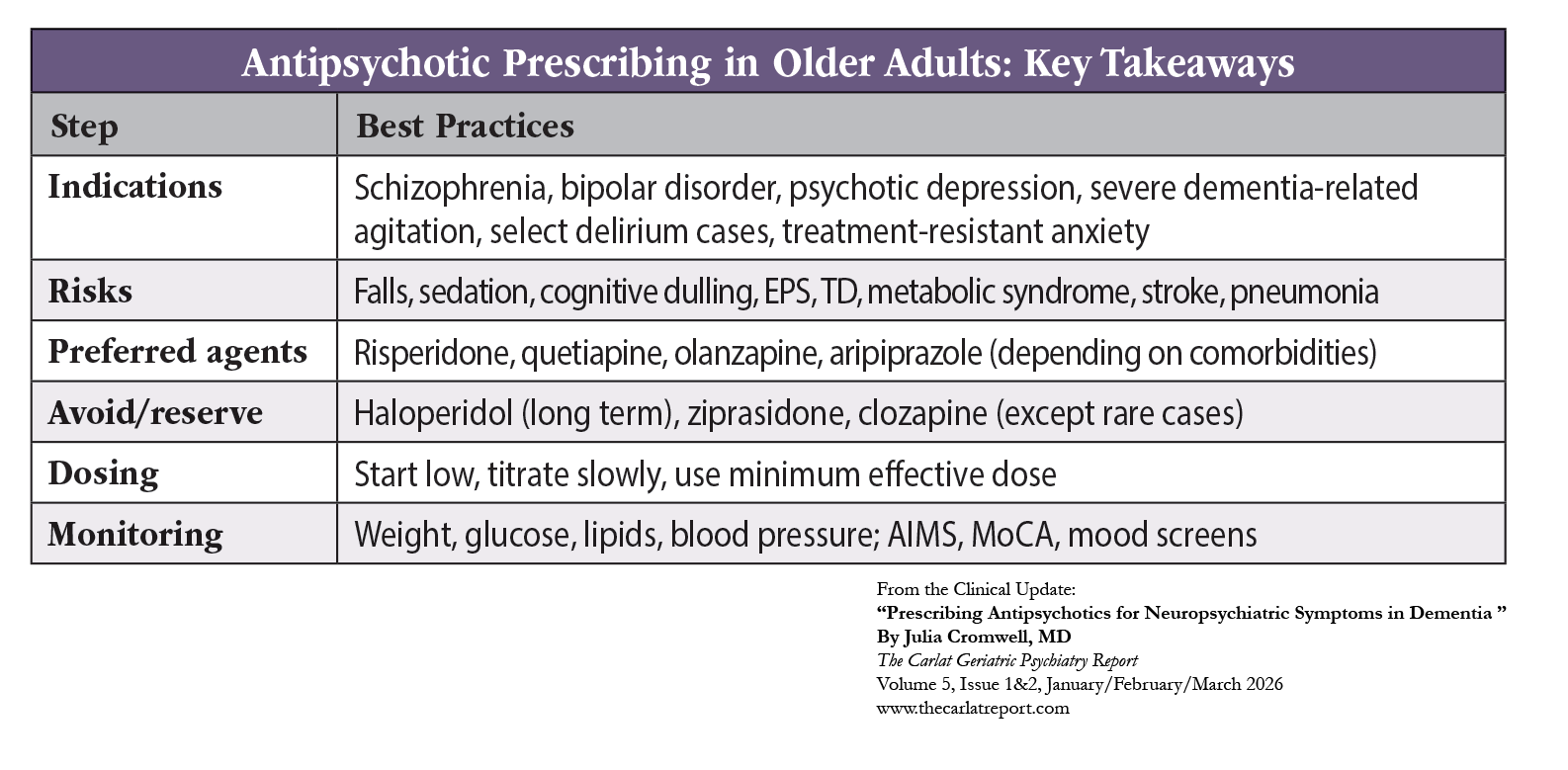
Carlat Verdict: Antipsychotics can help manage severe agitation or psychosis in dementia, but in older adults they carry profound risks. Use them sparingly, start low and go slow, monitor closely, and document thoroughly. Always plan for regular reassessment, and deprescribe when the medication is no longer clinically useful.


Recommended