_-The-Breakthrough-Antipsychotic-That-Could-Change-Everything.webp?t=1729528747 "KarXT (Cobenfy)_ The Breakthrough Antipsychotic That Could Change Everything.jpg")
Expert Q&A
Ambulatory Alcohol Withdrawal: A Practical How-To

Getting your Trinity Audio player ready...
CATR: How common is alcohol use disorder (AUD), and how do you bring it up with patients?
Dr. Holt: It’s very common. Roughly 20–25 million people in the US meet criteria for AUD. Between 10% and 20% of hospitalized patients have AUD, and you’ll see similar proportions in primary care panels (Subhani M et al, J Clin Med 2024;13(24):7617). Beyond that, there are at least twice as many people with “unhealthy alcohol use”—they exceed accepted consumption limits and are at risk for consequences even if they don’t meet DSM-5 criteria. In other words, no matter your specialty, you will see alcohol and its effects. Because alcohol use is stigmatized, I don’t lead with it any more than I’d begin an interview with cocaine use or a detailed sexual history. I get to know why the patient is here, what matters to them today, and then I move into smoking, then alcohol. I’ll ask what they like to drink and use a simple single-question screener: “Over the past 30 days, was there an occasion that you consumed 5+ drinks in a sitting [for men] or 4+ [for women]?” (Smith PC et al, J Gen Int Med 2009;24(7):783–788). That opens the door to a more detailed discussion.
CATR: Trainees typically spend most of their time learning to manage withdrawal in a hospital, but most patients don’t necessarily require hospitalization. Who is a good candidate for ambulatory care, and what are the red flags that push you toward inpatient?
Dr. Holt: Of the ~20 million people with AUD, about half will have no withdrawal at all if they stop abruptly. Among those who do have symptoms, fewer than 5% develop severe complications like seizures or delirium tremens (DTs). So the overwhelming majority can be treated safely outside the hospital. From there I look at risk factors, most of which are relative, not absolute. Prior complicated withdrawal strongly predicts future complications. Patients who have had DTs, had alcohol-withdrawal seizures, or needed ICU intubation or other ICU-level care all push me toward inpatient. Medical comorbidities matter because our withdrawal treatments are sedatives themselves. If someone has COPD and already needs oxygen, or has severe obstructive sleep apnea, I’m cautious about unsupervised benzodiazepines (BZDs). I’m also careful with heart failure and end-stage renal disease; pregnancy is another situation to approach with great caution. The Prediction of Alcohol Withdrawal Severity Scale can be a helpful tool (www.tinyurl.com/4j9dv9sx).
CATR: What about social factors?
Dr. Holt: External realities are important to consider, too. If the person is unhoused, with no reliable way to be reached by phone, no transportation, and no one to check in on them—those all add up and may tip you toward inpatient. Active comorbid substance use can complicate things as well. Ongoing fentanyl or other opioid use, very high-dose methadone, or a sedative-hypnotic use disorder all give me pause. Finally, alcohol withdrawal can be uncomfortable and destabilizing. So, psychiatric instability will push me toward inpatient treatment. By that, I mean recent active suicidality, psychosis, or significant cognitive impairment that would make it impossible to follow an outpatient plan—those are red flags.
CATR: Any other factors that are important to consider?
Dr. Holt: As I said, these factors are generally relative contraindications. So, unless it’s very clear that outpatient withdrawal management would be dangerous or otherwise entirely unfeasible, I always bring the patient’s preference into the balance. Many people have had miserable hospital experiences: stigma, discrimination, neglect, feeling dehumanized. Some will do anything to avoid returning. If I stack up relative contraindications and decide inpatient is safer, but the alternative is to turn them away and tacitly tell them to keep drinking a pint or two of vodka daily with no plan, I will often choose to help them as an outpatient—as long as they demonstrate that they understand the risks and can articulate that hospitalization is my recommendation. We can’t let perfection be the enemy of good. The one absolute for me is capacity: If you lack decision-making capacity, I can’t safely hand you controlled sedatives. But outside of that, it all comes down to a patient-centered risk-benefit analysis, and if the patient declines to go to the hospital despite my recommendation, I am sure to document that carefully.
CATR: Let’s say you and the patient agree on an ambulatory plan. Walk us through your protocol.
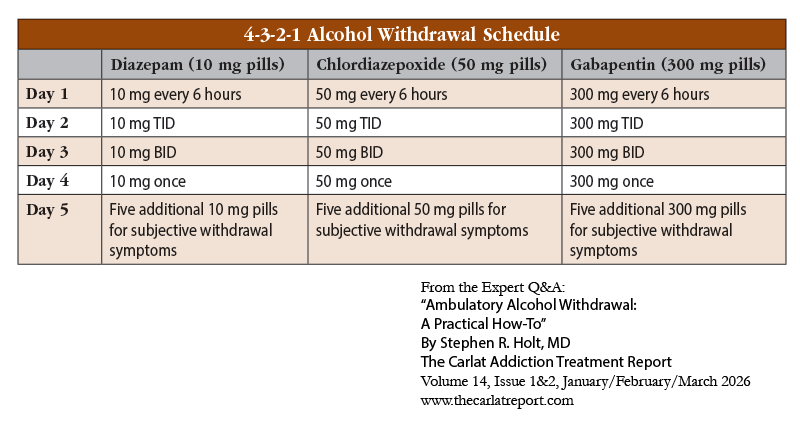
Dr. Holt: Timing and framing matter. Often, I’m seeing someone mid-afternoon who has already had a few drinks to stave off morning jitters. I like to start the tapers from a clean slate. If there’s alcohol in their system, we’ll start the withdrawal protocol the next morning. I’ll tell them, “Today’s job is to get to the pharmacy. Tomorrow, you stop drinking. I want the first dose on the bedside table, so the day starts with the medication, not alcohol.” The taper itself is a 4-3-2-1 schedule over four days, using either a long-acting BZD (diazepam or chlordiazepoxide) or sometimes gabapentin. If the patient has cirrhosis, we use lorazepam. The schedule is the same regardless of agent—day 1: up to four doses spaced roughly every six hours; day 2: up to three doses; day 3: up to two doses; day 4: one dose. I emphasize flexibility: If they feel fine or sleepy, they can skip a dose. I also provide five additional PRN doses for the entire taper, with clear guidance: “If you need more than one PRN on a given day, we need to talk, because it may mean the outpatient setting isn’t safe enough.”
CATR: And what constitutes a dose for each medication?
Dr. Holt: For diazepam a dose is a single 10 mg tablet, for chlordiazepoxide it’s 50 mg capsules, and for gabapentin it’s a 300 mg capsule. The 4-3-2-1 schedule applies across agents.
CATR: How do you decide whether to go with gabapentin versus a BZD?
Dr. Holt: Most guidelines specify BZDs as the first-line treatment. However, there are numerous head-to-head trials comparing BZDs with anticonvulsants like gabapentin and carbamazepine (Myrick H et al, Alcohol Clin Exp Res 2009;33(9):1582–1588; Malcolm R et al, J Gen Intern Med 2002;17(5):349–355). The anticonvulsants are no less effective at preventing seizures, DTs, or hospitalization, and they’re less likely to cause sedation or “stacking” the way diazepam’s metabolites can. All else equal, my preference is gabapentin. Most clinicians are comfortable prescribing it, and you avoid some of the cognitive clouding that comes with BZDs. Two scenarios push me toward a BZD. First, when someone is already on high-dose gabapentin, for example 600 mg 3 times daily for neuropathy. In that scenario, I don’t expect much added benefit by piling on more gabapentin. Second, when I’m essentially doing “salvage” outpatient care for someone whom I truly want in the hospital but who initially refused. If they would have received a BZD inpatient, I may mirror that as an outpatient with careful monitoring.
CATR: How do you monitor patients during the four-day taper?
Dr. Holt: Frequent contact is essential, daily if possible. I don’t require daily video or clinic visits, but I do want a human check-in every day, either by me or a member of my team. Ideally, a patient will start on a Monday, I’ll see them in person that first day, then we’ll have daily phone calls for the rest of the taper, with an additional in-person appointment mid-taper. I do not want them driving on BZDs. On the phone I ask how many doses they’ve taken, as well as any PRNs. I ask how they feel—are they jittery, groggy, unable to focus? If I hear grogginess with four scheduled doses, we reassess. If they go back to drinking alcohol during the taper, the rule is simple: Stop the BZD immediately. We hit reset and plan a fresh start later. I don’t want the patient mixing BZDs and alcohol.
CATR: Do you use the Clinical Institute Withdrawal Assessment (CIWA) or other validated scales?
Dr. Holt: We get vital signs during the in-person visits, but otherwise, no. CIWA can be helpful for protocolized inpatient treatment and for research, but as a clinician I can assess withdrawal through a conversation without scoring.
CATR: Do you obtain labs or give thiamine and folate in the outpatient setting?
Dr. Holt: In a perfect world, yes. But those aren’t my priority. If logistics allow, a comprehensive metabolic panel is nice to have, but I won’t delay treatment for labs. The immediate problem is the active poison. Gabapentin is renally cleared, so I’m not waiting on liver tests to start it. Likewise, thiamine and folate are great; if I’m confident about adherence or that they won’t get in the way, I’ll prescribe them. But I try to limit the number of moving pieces in those first four days. Hospital order sets are full of lab checks and infusions because the infrastructure is there, but that’s not the case in the outpatient setting. Here, the focus is getting the meds, starting on time, and checking in daily.
CATR: What about patients with cirrhosis?
Dr. Holt: Even in people with significant liver disease, up to Child-Pugh B, you can still use long-acting BZDs like diazepam. Unless the patient’s liver disease is severe, my approach is just to go gentle with the diazepam and monitor closely. If the patient’s liver is very impaired, I’ll recommend hospitalization. From time to time, a patient with advanced liver disease refuses to go to the hospital, and for them I consider lorazepam, still utilizing a 4-3-2-1 approach with 2 mg doses.
“We can’t let perfection be the enemy of good. The one absolute for me is capacity: If you lack decision-making capacity, I can’t safely hand you controlled sedatives. But outside of that, it all comes down to a patient-centered risk-benefit analysis, and if the patient declines to go to the hospital despite my recommendation, I am sure to document that carefully.”
Stephen R. Holt, MD
CATR: For patients treated with gabapentin, do you ever continue the gabapentin after the withdrawal is complete?
Dr. Holt: Sometimes, yes. It’s more art than science here. My personal experience is that gabapentin as maintenance works best in people who truly have a withdrawal phenotype. These are people who feel withdrawal when they stop rather than those who may have unhealthy use but don’t have distinct withdrawal symptoms. If a patient tells me gabapentin made the first successful stop possible, then I’m comfortable continuing it. Up to 600 mg three times daily is reasonable. But in the big picture of maintenance for AUD, I consider acamprosate, naltrexone (oral or intramuscular), and topiramate as first-line options, with gabapentin as a useful tool in the right patient. There is some disagreement among providers about the utility of disulfiram, but I think when paired with direct observation, disulfiram should also be considered first line (Holt S, J Addict Med 2024;18(6):614–616).
CATR: How do you handle co-occurring substance use, particularly opioids?
Dr. Holt: If there’s active illicit opioid use, that takes precedence. Alcohol is toxic and causes all sorts of long-term harm, but fentanyl can kill you today. I stabilize the opioid use disorder first. If someone is in remission and is already on, say, buprenorphine, then my plan doesn’t really change. Buprenorphine plus modest amounts of BZDs isn’t a combination I worry about in a clinically significant way, especially for people already highly tolerant to alcohol. Methadone is different; I’m more cautious about pairing methadone with BZDs. In that group, I steer toward gabapentin for outpatient withdrawal if possible. And if someone is on daily methadone, I take advantage of the fact they’re being seen daily and coordinate closely with their clinic.
CATR: What do you do if the patient’s first visit lands, say, on a Friday afternoon?
Dr. Holt: That’s common. As I said, I don’t let perfection be the enemy of the good. The approach is the same. If a clinic has the capacity to place weekend calls, that’s great. Otherwise, I make sure I speak to the patient Friday and then again first thing on Monday.
CATR: What guidance do you give the patient about when to call you immediately or when they should go to the hospital?
Dr. Holt: On the first day, I go over warning signs that the withdrawal might not be properly controlled with the medications I’m prescribing. I say that if they develop the following symptoms, they need to go to the hospital right away: severe tremors (by which I mean tremors that make it difficult to easily drink a glass of water), visual or auditory hallucinations, and confusion. Having a seizure is an obvious indication that they should go to the hospital, but if the patient is alone, they may not even be aware that they had a seizure. So I tell them, “If you find yourself on the floor and you don’t know how you got there, or you experience lost time, you should call 911 or go to the hospital.”
CATR: Let’s talk about the transition to maintenance. What do you start, and when?
Dr. Holt: I like to strike while the iron is hot. There’s a reason the person has chosen abstinence now; I don’t want to miss that opportunity. I aim to start maintenance on the last day of the taper—the fourth or fifth day—so there’s no gap. After that, I see the patient weekly early on. This is a volatile period, and I want to layer supports: mutual help, counseling, whatever aligns with their goals (Editor’s note: For more, see “Medications for Alcohol Use Disorder: An Overview” in CATR March/April 2022).
CATR: Any other final tips?
Dr. Holt: Keep the patient at the center. Take their preferences into account and tailor your plan to what you think they will be able to adhere to. Maintain flexibility whenever you can, while of course doing your best to keep the patient safe. And don’t forget about maintenance treatment. Managing withdrawal is important, but treating the AUD after withdrawal is essential to give the patient their best chance at staying sober.
CATR: Thank you for your time, Dr. Holt.




Recommended