• Home
  • Store
    • Total Access Subscriptions
    • Newsletter Subscriptions
    • Multimedia
    • Books
    • eBooks
    • ABPN SA Courses
    • Institutional Site Licenses
  • CME Center
  • Multimedia
    • Podcast
    • Webinars
    • Blog
  • Newsletters
    • General Psychiatry
    • Child Psychiatry
    • Addiction Treatment
    • Hospital Psychiatry
    • Geriatric Psychiatry
    • Psychotherapy and Social Work
  • Toolkit
  • FAQs
  • Log In
  • Register
  • Welcome
  • Sign Out
  • Subscribe
Access Purchased Content
Home » psychotherapy

Articles Tagged with ''psychotherapy''

The Psychotherapy of Bipolar Disorder and the Moment of Truth

October 1, 2011
From The Carlat Psychiatry Report
Issue Links: Learning Objectives | Editorial Information | PDF of Issue
Descartes Li, MD
If you treat patients with bipolar disorder, then you have reached what I call the moment of truth. Your patient has been doing so well, she’s not even sure she still has a psychiatric problem. This is one of the many opportunities for psychotherapy in bipolar disorder—in this case, helping your patient to come to terms with her illness.
Read More

Antidepressants Versus Psychotherapy for Depression

October 1, 2011
From The Carlat Psychiatry Report
Issue Links: Learning Objectives | Editorial Information | PDF of Issue
Glen Spielmans, PhD
Research has generally found that both antidepressants and psychotherapy offer similar efficacy in the short-term, but that after treatment discontinuation, results are better with psychotherapy.
Read More

Psychodynamic Therapy

October 1, 2011
From The Carlat Psychiatry Report
Issue Links: Learning Objectives | Editorial Information | PDF of Issue
I examined results of multiple meta-analyses published in top tier, peer reviewed journals. The findings were clear and consistent: effect sizes for psychodynamic psychotherapy are at least as large as those reported for other therapies that are promoted as “empirically supported” or “evidence based.” Also, the benefits of psychodynamic therapy are lasting. Patients not only improve, but continue to improve even after therapy ends.
Read More

Exposure and Response Prevention Therapy for OCD

July 1, 2011
From The Carlat Psychiatry Report
Issue Links: Learning Objectives | Editorial Information | PDF of Issue
Exposure and response prevention (ERP) is an extremely effective therapy. You can say with conviction that if a patient commits to this therapy, it really has a good chance of reducing suffering.
Read More

Cognitive Behavioral Therapy for Panic Disorder

July 1, 2011
From The Carlat Psychiatry Report
Issue Links: Learning Objectives | Editorial Information | PDF of Issue
Some of the CBT techniques that have proven effective for panic disorder include breathing retraining, cognitive restructuring, and relaxation training.
Read More

Novel Program Effective for Anxiety Disorders in Primary Care

July 1, 2011
From The Carlat Psychiatry Report
Issue Links: Learning Objectives | Editorial Information | PDF of Issue
Jamie Horder, MD
Anxiety disorders are commonly seen in primary care, whether they present on their own, or comorbid with other illnesses. There’s good evidence for both cognitive-behavioral therapy (CBT) and pharmacotherapy in anxiety disorders, but many patients don’t receive such treatment.
Read More

Habit Reversal Training: Optimal Treatment for Tics

June 1, 2011
From The Carlat Child Psychiatry Report
Issue Links: Learning Objectives | Editorial Information | PDF of Issue
Caroline Fisher, PhD, MD
Habit reversal training (HRT) is a form of Cognitive Behavioral Therapy that systematically targets tics.


Read More

IPT for Patients with Early Trauma Histories?

May 1, 2011
From The Carlat Psychiatry Report
Issue Links: Learning Objectives | Editorial Information | PDF of Issue
Section editor, Glen Spielmans, PhD
We know that psychotherapy is generally effective for depression, but we don’t really know which depressed patients will respond better than others.
Read More

Adding Psychosocial Interventions Can Improve Outcomes in Schizophrenia

December 1, 2010
From The Carlat Psychiatry Report
Issue Links: Learning Objectives | Editorial Information | PDF of Issue
Section editor, Glen Spielmans, PhD
Medication discontinuation is alarmingly common among patients with schizophrenia—it may range anywhere from 42% to 74%.
Read More

How Do Psychotherapy and Medication Change the Brain?

September 1, 2010
From The Carlat Psychiatry Report
Issue Links: Learning Objectives | Editorial Information | PDF of Issue
Daniel Carlat, MD
We know that for many conditions, both medications and psychotherapy work about equally well. Common sense would dictate that there is some final common pathway of neuropsychiatric change underlying the symptomatic improvements we see. But identifying what is happening in a living human brain is extremely tricky.
Read More
Previous 1 2 … 15 16 17 18 19 20 21 22 23 Next
Try The New AskCarlat AI

Ask any clinical question—our AI responds using only the peer-reviewed, editorially vetted content from Carlat Publishing.

Available In The Carlat Toolkit
Free Psychiatry Updates
The latest unbiased psychiatric information sent to your inbox.
Specify Your Interests
Featured Book
  • MFB8e_SpiralCover.png

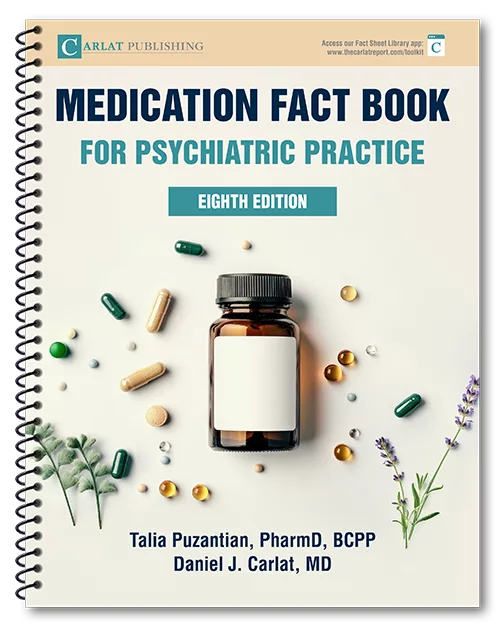
    Medication Fact Book for Psychiatric Practice, Eighth Edition (2026)

    Updated 2026 prescriber's guide.
    READ MORE
Featured Video
  • KarXT (Cobenfy)_ The Breakthrough Antipsychotic That Could Change Everything.jpg
    General Psychiatry

    KarXT (Cobenfy): The Breakthrough Antipsychotic That Could Change Everything

    Read More
Featured Podcast
  • Posner.png
    Psychology and Social Work

    CBT-I: The First-Line Treatment for Chronic Insomnia with Dr. Donn Posner (Part 1 of 2)

     Dr. Donn Posner is a leading expert in cognitive behavioral therapy for insomnia (CBT-I) and one of the field's most active educators.


    Listen now
Recommended
  • Join Our Writing Team

    July 18, 2024
    WriteForUs.png
  • Insights About a Rare Transmissible Form of Alzheimer's Disease

    February 9, 2024
    shutterstock_2417738561_PeopleImages.com_Yuri A.png
  • How to Fulfill the DEA's One Time, 8-Hour Training Requirement for Registered Practitioners

    May 24, 2024
    DEA_Checkbox.png
  • Join Our Writing Team

    July 18, 2024
    WriteForUs.png
  • Insights About a Rare Transmissible Form of Alzheimer's Disease

    February 9, 2024
    shutterstock_2417738561_PeopleImages.com_Yuri A.png
  • How to Fulfill the DEA's One Time, 8-Hour Training Requirement for Registered Practitioners

    May 24, 2024
    DEA_Checkbox.png
  • Join Our Writing Team

    July 18, 2024
    WriteForUs.png
  • Insights About a Rare Transmissible Form of Alzheimer's Disease

    February 9, 2024
    shutterstock_2417738561_PeopleImages.com_Yuri A.png
  • How to Fulfill the DEA's One Time, 8-Hour Training Requirement for Registered Practitioners

    May 24, 2024
    DEA_Checkbox.png

About

  • About Us
  • CME Center
  • FAQ
  • Contact Us

Shop Online

  • Newsletters
  • Multimedia Subscriptions
  • Books
  • eBooks
  • ABPN Self-Assessment Courses

Newsletters

  • The Carlat Psychiatry Report
  • The Carlat Child Psychiatry Report
  • The Carlat Addiction Treatment Report
  • The Carlat Hospital Psychiatry Report
  • The Carlat Geriatric Psychiatry Report
  • The Carlat Psychotherapy Report

Contact

carlat@thecarlatreport.com

866-348-9279

PO Box 626, Newburyport MA 01950

Follow Us

Please see our Terms and Conditions, Privacy Policy, Subscription Agreement, Use of Cookies, and Hardware/Software Requirements to view our website.

© 2026 Carlat Publishing, LLC and Affiliates, All Rights Reserved.