• Home
  • Store
    • Total Access Subscriptions
    • Newsletter Subscriptions
    • Multimedia
    • Books
    • eBooks
    • ABPN SA Courses
    • Institutional Site Licenses
  • CME Center
  • Multimedia
    • Podcast
    • Webinars
    • Blog
  • Newsletters
    • General Psychiatry
    • Child Psychiatry
    • Addiction Treatment
    • Hospital Psychiatry
    • Geriatric Psychiatry
    • Psychotherapy and Social Work
  • Toolkit
  • FAQs
  • Log In
  • Register
  • Welcome
  • Sign Out
  • Subscribe
Access Purchased Content
Home » Does Ketamine’s Effect on Suicidality Stick Around?
Research Update

Does Ketamine’s Effect on Suicidality Stick Around?

June 1, 2026
From The Carlat Psychiatry Report
Issue Links: Editorial Information | PDF of Issue

Hassan Mobarak, MD. Dr. Mobarak has no financial relationships with companies related to this material.

PDF


Getting your Trinity Audio player ready...

REVIEW OF: Pan Y et al, Transl Psychiatry 2024;14(1):327
STUDY TYPE: Retrospective cohort study

Ketamine is one of the few medications in psychiatry that reduces suicidal ideation (SI). But how well does it work in the long run? This study used real-world data to see if ketamine’s effects on suicidality in recurrent major depressive disorder (MDD) last.

This US-based study looked at 514,988 patients with a new diagnosis of recurrent MDD who were prescribed antidepressant treatment. From this group, researchers identified 22,014 patients who received ketamine plus or minus other antidepressants. They matched them with an equal number of patients who had similar characteristics and were treated with other antidepressants, but not ketamine. Using electronic health records (EHRs), they tracked diagnoses of SI in the EHR at one week and then one, three, six, and nine months. The effect of ketamine on SI risk was assessed using hazard ratios (HRs).

Ketamine outperformed other antidepressants in both the short and long terms. In the first month, ketamine lowered the risk of SI by about 33% (HR = 0.67; 95% confidence interval [CI]: 0.59–0.77). Over nine months, the reduction was about 22% (HR = 0.78; 95% CI: 0.69–0.83). The benefit was especially strong for adults over 24 and White patients. The difference between ketamine and other treatments gradually narrowed from one to nine months but remained statistically significant.

CARLAT TAKE
This large but observational study finds that ketamine is associated with less mention of suicide in charts than other antidepressants. We don’t know if patients got the meds they were prescribed, how their depressions themselves fared, or if doctors documented ketamine-associated care differently. That said, these results are encouraging and favor ketamine when patients with recurrent MDD suffer from suicidality.
General Psychiatry
KEYWORDS Ketamine Research Update suicidality
    www.thecarlatreport.com
    Issue Date: June 1, 2026
    SUBSCRIBE NOW
    Table Of Contents
    Learning Objectives, Therapy for Bipolar Disorder, TCPR, June/July 2026
    Street Smarts in Psychopharm: What Every Clinician Needs to Know
    Therapy for Bipolar Disorder
    Digital Addictions
    The Obsessive-Compulsive Disposition
    Does Ketamine’s Effect on Suicidality Stick Around?
    CBD for Trauma-Related Anxiety: Does the Hype Add Up?
    Legal Gender Change Stability
    Propranolol Plus Sertraline for Panic in Women
    SNRIs Appear Less Harmful to Bone Than SSRIs in Postmenopausal Women
    CME Post-Test, Therapy for Bipolar Disorder, TCPR, June/July 2026
    DOWNLOAD NOW
    Featured Book
    • MFB8e_SpiralCover.png

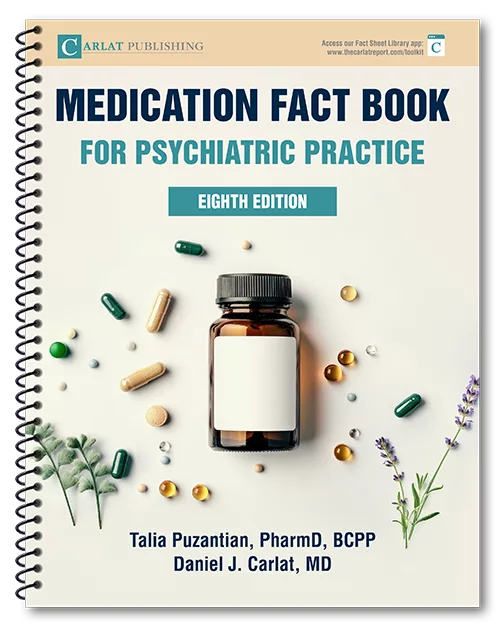
      Medication Fact Book for Psychiatric Practice, Eighth Edition (2026)

      Updated 2026 prescriber's guide.
      READ MORE
    Featured Video
    • KarXT (Cobenfy)_ The Breakthrough Antipsychotic That Could Change Everything.jpg
      General Psychiatry

      KarXT (Cobenfy): The Breakthrough Antipsychotic That Could Change Everything

      Read More
    Featured Podcast
    • shutterstock_2782224449.jpg
      General Psychiatry

      Gender Affirming Care: Fall of the House of Hopkins

      Listen now
    Recommended
    • Join Our Writing Team

      July 18, 2024
      WriteForUs.png
    • Insights About a Rare Transmissible Form of Alzheimer's Disease

      February 9, 2024
      shutterstock_2417738561_PeopleImages.com_Yuri A.png
    • How to Fulfill the DEA's One Time, 8-Hour Training Requirement for Registered Practitioners

      May 24, 2024
      DEA_Checkbox.png
    • Join Our Writing Team

      July 18, 2024
      WriteForUs.png
    • Insights About a Rare Transmissible Form of Alzheimer's Disease

      February 9, 2024
      shutterstock_2417738561_PeopleImages.com_Yuri A.png
    • How to Fulfill the DEA's One Time, 8-Hour Training Requirement for Registered Practitioners

      May 24, 2024
      DEA_Checkbox.png
    • Join Our Writing Team

      July 18, 2024
      WriteForUs.png
    • Insights About a Rare Transmissible Form of Alzheimer's Disease

      February 9, 2024
      shutterstock_2417738561_PeopleImages.com_Yuri A.png
    • How to Fulfill the DEA's One Time, 8-Hour Training Requirement for Registered Practitioners

      May 24, 2024
      DEA_Checkbox.png

    About

    • About Us
    • CME Center
    • FAQ
    • Contact Us

    Shop Online

    • Newsletters
    • Multimedia Subscriptions
    • Books
    • eBooks
    • ABPN Self-Assessment Courses

    Newsletters

    • The Carlat Psychiatry Report
    • The Carlat Child Psychiatry Report
    • The Carlat Addiction Treatment Report
    • The Carlat Hospital Psychiatry Report
    • The Carlat Geriatric Psychiatry Report
    • The Carlat Psychotherapy Report

    Contact

    carlat@thecarlatreport.com

    866-348-9279

    PO Box 626, Newburyport MA 01950

    Follow Us

    Please see our Terms and Conditions, Privacy Policy, Subscription Agreement, Use of Cookies, and Hardware/Software Requirements to view our website.

    © 2026 Carlat Publishing, LLC and Affiliates, All Rights Reserved.