Expert Q&A
Psychopharmacology for PTSD
Getting your Trinity Audio player ready...
TCPR: Where do you start with medications for PTSD?
Dr. Osser: When it comes to medications, the first thing I address is sleep. Sleep problems are central to PTSD. Most patients have them, and when their sleep improves, they function better and their daytime symptoms improve as well. Another reason we start with sleep is that the SSRIs—though FDA approved for PTSD—can make these sleep problems worse.
TCPR: What type of sleep problems do you see in PTSD?
Dr. Osser: Patients have trouble falling and staying asleep, as well as disturbed awakenings—whether waking up from a nightmare or not. They suddenly sit up in bed with anxiety, sweats, hyperventilation, and tachycardia. They get up and look around for danger, check locks, look out the window. Their thoughts are racing with worries and bad memories. Another common phenomenon is sleep terrors. That’s when patients thrash about in their sleep, kicking the sheets all over. They may hit their bed partner without any awareness of what they are doing and no memory of it the next day. They may be moaning, crying, yelling. Sleep apnea is also common in PTSD, and thus usually needs treatment, but we start with prazosin for most of the PTSD sleep problems. This antihypertensive has 10 placebo-controlled trials, of which 7 were positive, many with large effect sizes on sleep, nightmares, and even daytime symptoms of PTSD.
TCPR: How do you start prazosin?
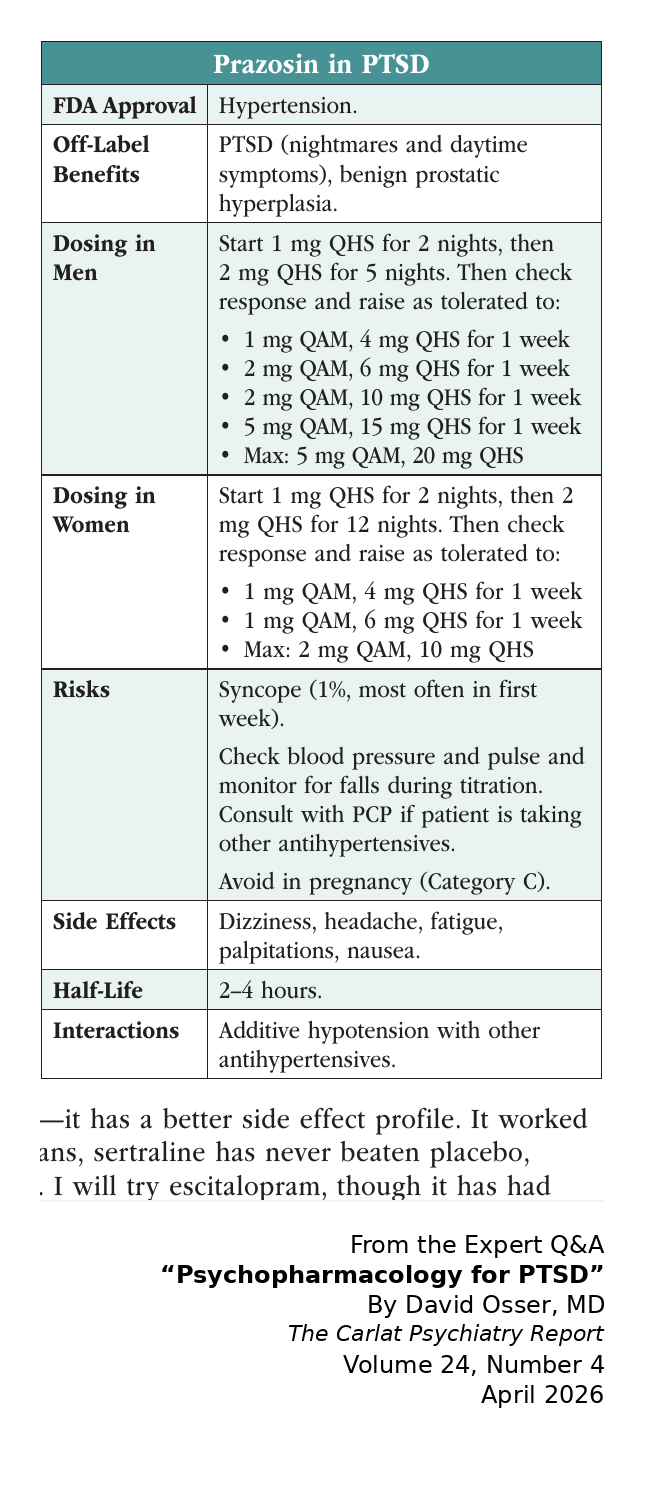
Dr. Osser: I follow the protocol from an early trial and slow it down if they get dizzy. If they are taking other antihypertensives, I’ll consult with their PCP about reducing some, but I wouldn’t avoid it. Patients with hypertension are more likely to respond to prazosin in PTSD.
TCPR: What do you look for in response?
Dr. Osser: My goal is zero sleep disturbance—no nightmares, disturbed awakenings, or sleep terrors. A prazosin trial takes time. You have to see the patient more often and adjust the dose carefully, much as you’d do with a lithium trial. Most clinicians do not go high enough. In some trials, the median nighttime dose was 16 mg for men and 7 mg for women, with an additional 1–5 mg in the morning. If I add a morning dose, I’ll tell them to take it around 10–11 am to avoid any overlap with their nighttime dose. Prazosin itself is not very sedating—no more than a placebo. Rather, it improves sleep quality and nocturnal hyperarousal.
TCPR: What do you add the morning dose for?
Dr. Osser: I tend to stick with nighttime dosing as long as their sleep is improving, but I will add a daytime dose for symptoms like irritability. They go into a fight-or-flight response when something reminds them of the trauma. They can’t be in crowds. They scan people at restaurants. They feel people are pushing their buttons. Sometimes this gets misdiagnosed as generalized anxiety disorder because they are anxious in so many situations. I’ve seen this irritability misdiagnosed as bipolar mania.
TCPR: Some doubt prazosin because it had a large negative trial in PTSD (Raskind MA et al, N Engl J Med 2018;378(6):507–517).
Dr. Osser: Negative studies are common in psychiatry, but prazosin is still positive in meta-analyses and systematic reviews that included that study, and it’s now backed by seven trials with large effect sizes, including civilian and military PTSD (Lappas AS et al, Sleep Med 2024;119:467–479; Mendes TP et al, Prog Neuropsychopharmacol Biol Psychiatry 2025;136:111253; Guo P et al, Acta Psychiatr Scand 2025;151(2):142–151). The study you mention may have been negative because it enrolled patients who were less likely to respond to prazosin. They had normal blood pressure (which predicts poor response), and they recruited from centers that were already using a lot of prazosin, so the best responders were not going to enroll.
TCPR: How do you avoid falls with prazosin?
Dr. Osser: Falls are much more common if you start at 2 mg, so the PDR recommends starting at 1 mg. I also advise patients: “When you first start taking it, sit on the edge of your bed for 30 seconds before standing up. If you’re not dizzy, stand up while holding on to a support. Use the same precautions when getting off the toilet. Also, test if you can bend over to pick up something without dizziness.”
TCPR: What is your second choice after prazosin?
Dr. Osser: I’ll consider clonidine next if the patient did not respond to prazosin. I would start with 0.1 mg ER and titrate toward 0.4 mg (often divided every 12 hours). I used to recommend trazodone, but though it does help with falling asleep and I may add it for that, we don’t see improvement in nightmares or disturbed awakenings like we do with prazosin and clonidine. I also once recommended doxazosin if patients did not tolerate the hypotensive effects of prazosin, because of its longer half-life and some benefit in one controlled trial, though it doesn’t cross the blood-brain barrier very well. But two recent RCTs found little benefit, so I’ve been avoiding it (Back SE et al, J Clin Psychiatry 2023;84(2):21m14367; Richards A et al, J Clin Sleep Med 2025;21:2165–2179).
TCPR: Why clonidine?
Dr. Osser: Clonidine has zero controlled trials in PTSD, so this is not a high level of evidence, but there is an impressive case series from the VA in Chicago (Burek GA et al, J Psychiatry Res 2021;137:480–485). However, clonidine is more likely to cause hypotension than prazosin, so if they had hypotension on prazosin, I would move instead to hydroxyzine for PTSD with sleep problems. Hydroxyzine beat placebo in one placebo-controlled trial of PTSD. I keep the dose around 10–12.5 mg BID and 25 mg QHS (Ahmadpanah M et al, Neuropsychobiology 2014;69(4):235–242). If you go too high, there is a risk of QT prolongation (above 100 mg) or daytime sedation.
TCPR: When do you use antidepressants in PTSD?
Dr. Osser: If they still have significant PTSD symptoms after addressing their sleep (and they don’t have bipolar disorder), I’ll consider an SSRI, though they all have small effect sizes in studies. Sertraline (50–200 mg QD) and paroxetine (20–50 mg QD) are FDA approved, and I prefer sertraline—it has a better side effect profile. It worked well in women with sexual trauma, but for combat-related PTSD in male veterans, sertraline has never beaten placebo, so I avoid it with them (Friedman MJ et al, J Clin Psychiatry 2007;68:711–720). I will try escitalopram, though it has had no significant study. I do not like paroxetine because of higher sexual side effects, weight gain, and unwanted sedation. Fluoxetine is okay to try, but effect size in its studies was tiny.
TCPR: And if SSRIs don’t work?
Dr. Osser: That depends on the symptoms. Some people with PTSD have psychotic features. We have to rule out psychotic disorders like schizophrenia and mood disorders with psychotic features. When the hallucinations are due to PTSD, their reality testing is intact, and they don’t have negative symptoms like you’d see in schizophrenia. The hallucinations are usually related to trauma, like a patient who heard the cries of dead bodies from Vietnam. Sometimes these hallucinations improve with the antidepressant treatment alone. When they don’t, we might add a second-generation antipsychotic. Risperidone has the best evidence for PTSD with psychotic features, followed by aripiprazole and quetiapine. Of those, aripiprazole tends to be the best tolerated, so I start there.
TCPR: What about brexpiprazole, which is trying to get FDA approval as a combination with sertraline in PTSD?
Dr. Osser: The FDA denied approval, and deservedly so, in my opinion. Also, it was not studied in patients with psychotic features or in those who failed the SSRI. Even if it were FDA approved, I would still prefer aripiprazole, which has a similar pharmacodynamics profile and lower cost. The VA pays $2 for a month’s supply of a typical dose of aripiprazole vs $890 for brexpiprazole.
TCPR: Putting psychotic symptoms aside, what if the patient just doesn’t respond to the SSRI?
Dr. Osser: I would try another SSRI or an SNRI. Venlafaxine (75–225 mg QD) and duloxetine (60–120 mg QD) are not approved, but they both beat placebo in PTSD—though they were no help for hyperarousal symptoms, which are very common in PTSD, maybe due to their noradrenergic stimulation effects. The patient could also try prazosin during the day, if they haven’t already (Hendrickson RC et al, Chronic Stress 2021:5:2470547020979780). We also have some evidence for topiramate, TMS, ketamine, and stellate ganglion block—a procedure that involves injecting a long-acting local anesthetic like ropivacaine or bupivacaine in the lower neck (Bajor LA et al, Psychiatry Clin Psychopharmacol 2025;35(Suppl 1):S135–S140).
TCPR: What about cannabis for PTSD?
Dr. Osser: Some groups are studying that, and PTSD is among the 50-odd indications for “medical marijuana” that are approved by various state governments, but I’m skeptical. So far the trials are negative (Bonn-Miller MO et al, PLOS One 2021;16(3):e0246990), and irritability may get worse with chronic use. A lot of patients smoke cannabis to calm themselves, but when it wears off their irritability and anger are worse, and they end up chasing it with more cannabis (Mammen G et al, J Clin Psychiatry 2018;79(4):17r11839).
TCPR: And benzodiazepines?
Dr. Osser: I haven’t been recommending them. There is only one controlled trial, which tested alprazolam in 10 patients with PTSD and insomnia. Unlike prazosin, it did not improve core PTSD symptoms (Braun P et al, J Clin Psychiatry 1990;51:236–238). Also, PTSD patients frequently become addicted to benzodiazepines. However, one meta-analysis mentioned earlier turned up an unexpected finding that benzodiazepines can enhance prazosin’s effect when used together (Mendes et al, 2025). This should be studied prospectively.
TCPR: Thank you for your time, Dr. Osser.



Recommended