Clinical Update
Deprescribing Benzodiazepines: A Practical Guide to Tapering

Getting your Trinity Audio player ready...
Margaret, a 68-year-old retired teacher, has been taking lorazepam, 1 mg twice daily, for the past three years following her husband’s death. Though the medication was initially prescribed for acute grief-related insomnia, she now finds herself unable to sleep without it and experiences morning drowsiness, which has led to two falls in recent months. When you suggest tapering, she becomes anxious: “Doctor, I can’t function without these pills.”
Benzodiazepines offer valuable short-term relief for anxiety and insomnia; however, their long-term use creates a clinical dilemma, balancing the well-documented risks of chronic use against the very real difficulties of tapering. A recent study surprised many by finding higher mortality in patients who discontinued long-term benzodiazepines compared to those who continued (Maust DT et al, JAMA Netw Open 2023;6(12):e2348557). This finding underscores the importance of careful planning when deprescribing these medications.
The risks of long-term benzodiazepine use
Benzodiazepines are initially effective, but their efficacy typically wanes after several months for anxiety and a few weeks for insomnia. The cognitive toll also becomes increasingly apparent with long-term use. Your patients may struggle with memory lapses, slower processing speed, and decreased attention—deficits that often go unrecognized as medication-related. Chronic benzodiazepine use increases acute respiratory failure and hypoxemia in patients with obstructive sleep apnea or COPD, and large cohort data show that long-term exposure predicts postoperative delirium in older surgical patients (Starks SC et al, Eur J Anaesthesiol 2025;42(8):704–713).
Motor impairment presents even more immediate dangers. Chronic benzodiazepine users face a roughly 50% increased risk of falls, which is particularly hazardous in older adults. This impairment extends beyond the home: Studies show a 60%–80% increased risk of motor vehicle accidents, potentially doubling the risk of fatal crashes (Lader M, Addiction 2011;106(12):2086–2109).
Paradoxically, chronic benzodiazepine use can worsen mood and the very conditions they are meant to treat. Depression often emerges or deepens with long-term use but improves within months after successful tapering. Anxiety can intensify, particularly during interdose periods when the medication wears off.
Perhaps most concerning is the increased mortality risk associated with long-term use, though the exact magnitude is debated. Observational studies suggest that the risk may increase by over 40%. This is amplified dramatically when combined with opioids; benzodiazepines were detected in nearly half of opioid-related overdose deaths in the US in 2018, a four-fold increase from two decades prior (Gladden RM et al, MMWR Morb Mortal Wkly Rep 2019;68(34):737–744).
When to consider tapering
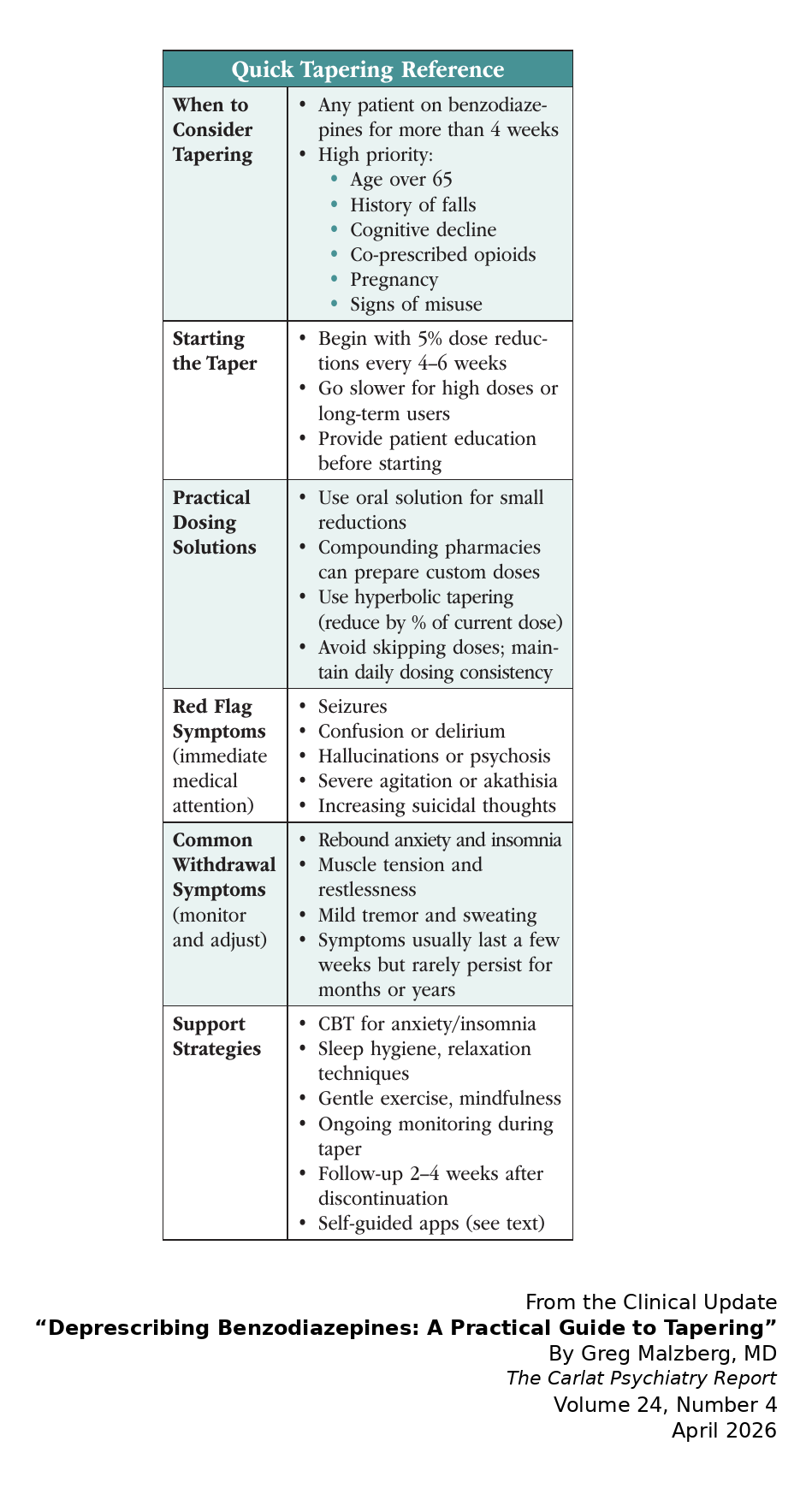
Consider deprescribing for most patients on benzodiazepines for longer than four weeks, unless clear contraindications exist. These include specific seizure disorders, end-of-life care, or severe mental illness where tapering risks destabilization.
Certain situations demand immediate attention. Co-prescription of opioids requires urgent intervention due to the risk of overdose—all prescribers should be coordinated, and naloxone provision should be considered. Other high-priority groups include pregnant individuals (fetal harm risk), adults over 65 years (increased sensitivity and fall risk), patients experiencing falls or cognitive decline, and patients showing signs of misuse, such as early refills or dose escalation.
Margaret’s age, fall history, and morning drowsiness place her in a high-priority category for tapering consideration.
Consider inpatient tapering for patients with significant medical or psychiatric instability, previous complicated withdrawal (seizures or delirium), recent overdose, or active suicidality. Some patients may request supervised rapid tapering, which can be more safely accommodated in inpatient settings.
Understanding the risks of tapering
Tapering benzodiazepines isn’t without risk. Mortality was found to be higher in patients who tapered off, even among older adults and those who used opioids (Maust et al, 2023). However, this study was not randomized, and its findings don’t override the substantial evidence that favors careful deprescribing when indicated.
The primary risk associated with tapering is withdrawal. Symptoms range from mild rebound anxiety, insomnia, and muscle tension to severe, life-threatening complications with abrupt cessation—psychosis, seizures, delirium, catatonia, and suicidality. Withdrawal akathisia, a state of severe inner restlessness, is particularly distressing and linked to increased suicide risk.
Some patients develop post-acute withdrawal syndrome (PAWS), where symptoms like anxiety, cognitive fog, paresthesias, tinnitus, and mood lability persist beyond the typical four- to six-week acute phase (Ashton H, J Subst Abuse Treat 1991;8(1–2):19–28). These symptoms can last months or even years. Recognizing PAWS prevents misdiagnosing it as a relapse or a new psychiatric condition.
When withdrawal symptoms prove intolerable or tapering attempts fail, maintaining patients on a reduced benzodiazepine dose may offer a viable harm-reduction strategy.
Patient education: Setting the stage for success
Thorough education sets the stage for successful tapering. Explain to your patient why you’re recommending this approach, reviewing long-term risks and potential benefits like improved cognition, better mood, and reduced fall risk. Help patients understand that withdrawal symptoms represent physiological adaptation, not evidence that they fundamentally “need” the medication.
Teach patients which symptoms warrant immediate contact: seizure activity, confusion or delirium, hallucinations, increasing suicidal thoughts, severe agitation, or akathisia. Emphasize that the taper will be gradual and flexible, adjusted based on their response.
Introduce coping strategies early: good sleep hygiene, relaxation techniques like mindfulness and deep breathing, gentle exercise, and potentially adjunctive psychotherapy such as CBT for insomnia or anxiety. These tools become invaluable during the tapering process. Useful apps include Sleep Coach, SleepioRx, and Somryst for insomnia, or AnxietyCoach, Breathe2Relax, Calm, DayLightRx, and Headspace for anxiety.
Practical tapering strategies
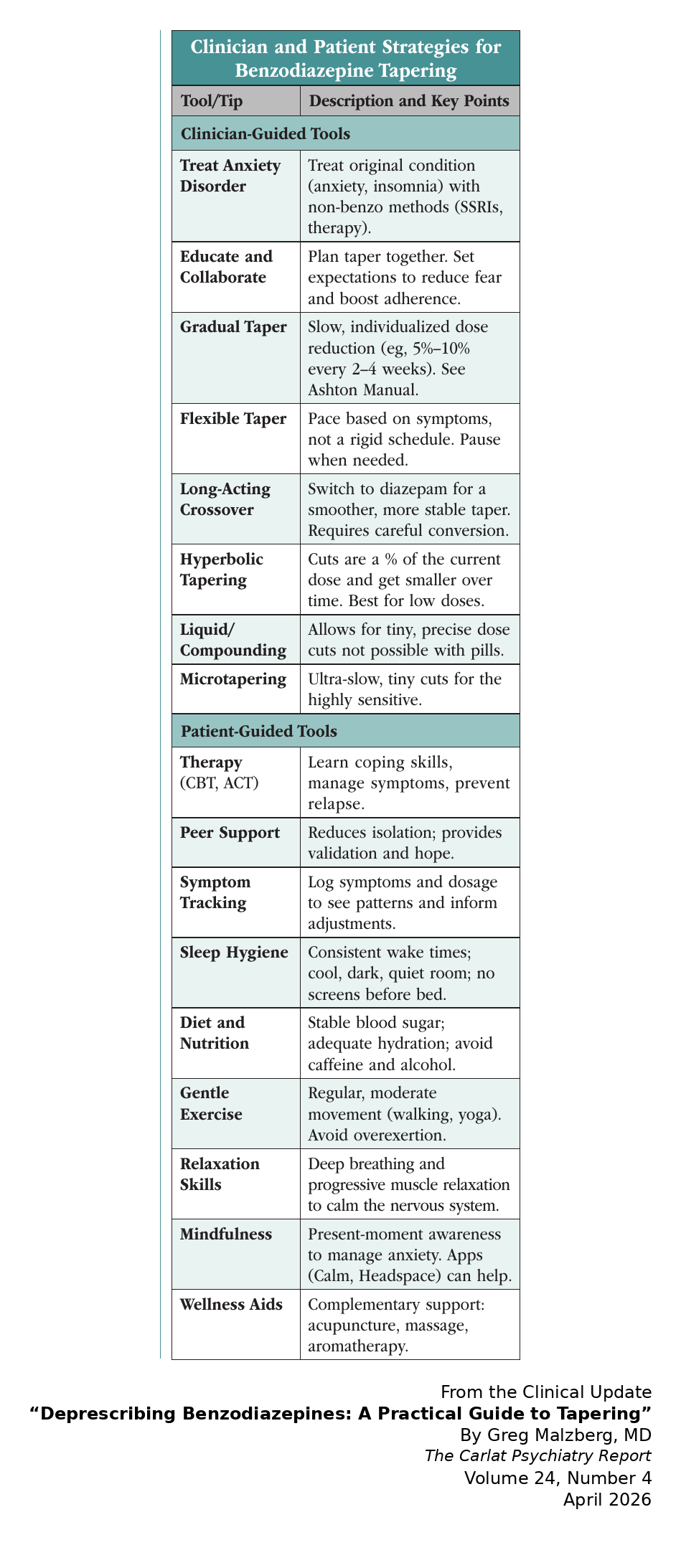
Successful tapering requires flexibility and a strong therapeutic alliance based on trust. Although no single protocol fits all scenarios, several principles guide each taper.
Some clinicians start by switching to an equivalent dose of a longer-acting benzodiazepine, such as diazepam. However, evidence supporting this practice is weak, and some patients are only able to taper off the benzo they came in on. A Cochrane review of this strategy was equivocal (Denis C et al, Cochrane Database Syst Rev 2006;(3):CD005194). In older adults, this strategy can bring additional risks, and long-acting benzodiazepines can accumulate in the body.
Tapering rate is crucial. Current guidelines favor starting slowly, especially for patients on long-term, high-dose regimens. Begin with 5% reductions, then proceed with 5%–10% decreases every 4–8 weeks or slower, based on patient tolerance. You must remain flexible: Pause the taper or slow the rate if withdrawal symptoms become significant. Avoid dose increases unless absolutely necessary. Liquid formulations are helpful, but it can be hard for patients to measure liquid medicine correctly. Give clear instructions using milliliters, and consider checking their technique for drawing the medication in an appointment before the taper starts.
Margaret begins her taper by reducing only her morning dose from 1 mg to 0.9 mg using a liquid formulation. After picking up the new medication from her pharmacy, she has a follow-up appointment where she brings it with her. During the visit, you review the tapering schedule and watch Margaret draw up a dose. Margaret is in agreement that you will discuss lowering the nighttime dose to 0.9 mg at her next appointment in a month.
Hyperbolic tapering can help when patients struggle as doses get lower. This method reduces a fixed percentage of the current dose, resulting in smaller absolute cuts at each step. This approach aligns with benzodiazepines’ nonlinear pharmacology and may help maintain consistent physiological responses. For diazepam, a hyperbolic schedule could look like 20 mg → 16.5 mg → 13.3 mg → 10.6 mg → 8.2 mg → 6.2 mg → 4.4 mg → 2.7 mg → 1.3 mg → 0 mg, with each step lowering GABA-A receptor occupancy by about 5 percentage points (Horowitz M and Taylor DM, The Maudsley Deprescribing Guidelines, 2024).
Practical aspects of dose reduction
Microdose reductions often require creative solutions. Diazepam’s 2 mg tablets allow smaller adjustments, and diazepam and lorazepam are available as oral solutions. You can achieve precise measurements using pipettes with liquid formulations, though this may challenge some patients. Compounding pharmacies can create custom-dose capsules, liquids, or tapering strips; however, this may be more expensive.
Avoid instructing patients to skip doses, as this can cause significant fluctuations in blood levels and trigger withdrawal, especially with shorter-acting agents. Consistent daily dose reduction is preferred.
Margaret successfully completes her taper over 12 months using a hyperbolic approach with liquid lorazepam. Her falls cease, her morning alertness improves, and her initial sleep difficulties resolve with CBT for insomnia. She now sleeps better than she has in years.



Recommended