• Home
  • Store
    • Total Access Subscriptions
    • Newsletter Subscriptions
    • Multimedia
    • Books
    • eBooks
    • ABPN SA Courses
    • Institutional Site Licenses
  • CME Center
  • Multimedia
    • Podcast
    • Webinars
    • Blog
  • Newsletters
    • General Psychiatry
    • Child Psychiatry
    • Addiction Treatment
    • Hospital Psychiatry
    • Geriatric Psychiatry
    • Psychotherapy and Social Work
  • Toolkit
  • FAQs
  • Log In
  • Register
  • Welcome
  • Sign Out
  • Subscribe
Access Purchased Content
Home » antipsychotics

Articles Tagged with ''antipsychotics''

The Experience of Correctional Psychiatry

May 1, 2016
Patrick Gariety, MD
From The Carlat Psychiatry Report
Issue Links: Learning Objectives | Editorial Information | PDF of Issue
Patrick Gariety, MDTCPR_May_Prison_Q&Aphoto_sm Psychiatrist at Group Health Behavioral Health Services, WA Dr. Gariety has disclosed that he has no relevant financial or other interests in any commercial companies pertaining to this educational activity.

Dr. Patrick Gariety shares his experiences as a treatment clinician working in a facility with about 300 psychiatric patients, staffed with five psychiatrists and eight psychologists. The psychiatric population was extremely mixed, with most of the patients suffering from some form of chronic mental illness, and/or severe personality disorders.
Read More

Second-Generation Antipsychotics Do Not Raise Risk of Major Malformations

May 1, 2016
Bret A. Moore, PsyD, ABPP
From The Carlat Psychiatry Report
Issue Links: Learning Objectives | Editorial Information | PDF of Issue
bret-a-moore-psyd-abppBret A. Moore, PsyD, ABPP Board-Certified Clinical Psychologist, San Antonio, TX Dr. Moore has disclosed that he has no relevant financial or other interests in any commercial companies pertaining to this educational activity.
Second-generation antipsychotics (SGA) are used for a variety of psychiatric conditions, but even though they’ve been around for 20 years, we know little about what impact they have on the developing fetus. These medications are widely considered to be relatively safe during pregnancy, but this assumption is based on scant evidence. In this paper, researchers tapped into the Massachusetts General Hospital (MGH) National Pregnancy Registry of Atypical Antipsychotics and reported some reassuring results.
Read More

Antipsychotic Polypharmacy: Helpful or Harmful?

January 1, 2016
Daniel Carlat, MD and Kelly N. Gable, Pharm.D
From The Carlat Psychiatry Report
Issue Links: Learning Objectives | Editorial Information | PDF of Issue
Kelly N. Gable, Pharm.D Associate Professor, SIUE School of Pharmacy Psychiatric Care Provider, Places for People Dr. Gable has disclosed that they have no relevant financial or other interests in any commercial companies pertaining to this educational activity.   Daniel Carlat, MD Editor-in-Chief, Publisher, The Carlat Report. Dr. Carlat has disclosed that he has no relevant relationships or financial interests in any commercial company pertaining to this educational activity.
Prescribing two antipsychotics to a single patient is a common practice in clinical settings. Increasingly, we are being scolded for this practice. If possible, stick with a single antipsychotic. But if the situation seems to call for polypharmacy, here are some factors to guide your decision-making.
Read More

Cariprazine (Vraylar): A drug for negative symptoms? Don’t be positive.

November 1, 2015
Talia Puzantian, PharmD, BCPP
From The Carlat Psychiatry Report
Issue Links: Learning Objectives | Editorial Information | PDF of Issue
Talia Puzantian, PharmD, BCPP Clinical psychopharmacology consultant in private practice, Los Angeles, CA. www.taliapuzantian.com Dr. Puzantian has disclosed that she has no relevant relationships or financial interests in any commercial company pertaining to this educational activity.
On September 17, the FDA approved cariprazine (Vraylar) for the treatment of schizophrenia and bipolar disorder. There’s already some buzz about whether this medication has advantages over other atypicals for treating negative symptoms of schizophrenia.

Read More

Foster Care and Child Psychiatry: A Primer

September 1, 2015
From The Carlat Child Psychiatry Report
Issue Links: Learning Objectives | Editorial Information | PDF of Issue
Glen R. Elliott, PhD, MD
Nearly one in three foster children have significant psychiatric problems during their time in foster care—especially those related to trauma and neglect that brought them into the system. This article is a brief primer on how foster care works, and how psychiatrists get involved.
Read More

Managing Psychotropic Treatment with Foster Children

September 1, 2015
From The Carlat Child Psychiatry Report
Issue Links: Learning Objectives | Editorial Information | PDF of Issue
Joshua Feder, MD
In response to the rising use of psychotropic medications in Medicaid and foster care populations, some states, including California, have implemented specific guidelines. This article covers those guidelines with case examples.
Read More

The New Three-Month Version of Injectable Paliperidone: Should You Use It?

June 1, 2015
Michael Posternak, MD
From The Carlat Psychiatry Report
Issue Links: Learning Objectives | Editorial Information | PDF of Issue
Michael Posternak, MD Psychiatrist in private practice in Boston, MA
Patients with schizophrenia often stop taking their medications, so long-acting injectable antipsychotics (LAIs) are potentially good ways to make sure these patients have some medication in their systems over the long term.
Read More

Should You Be Monitoring Serum Levels of Atypical Antipsychotics in Kids?

May 1, 2015
From The Carlat Child Psychiatry Report
Issue Links: Learning Objectives | Editorial Information | PDF of Issue
For better or worse, we are prescribing atypical antipsychotics more frequently in children. Some of this is due to new FDA indications for kids (autism, psychotic disorders, and bipolar disorder), but much of the increase is driven by off-label use (Tourette’s, ADHD, OCD, depression, conduct disorder and impulse control disorders).
Read More

Saphris Approved for Pediatric Bipolar Disorder—What Do the Data Show?

April 1, 2015
From The Carlat Child Psychiatry Report
Issue Links: Learning Objectives | Editorial Information | PDF of Issue
In March 2015, the US Food and Drug Administration (FDA) approved Actavis’ asenapine (Saphris) for the acute treatment of manic or mixed episodes associated with bipolar disorder in kids between 10 and 17 years.
Read More

Latuda: An Evaluation of Its Usefulness

February 1, 2015
Daniel Carlat, MD
From The Carlat Psychiatry Report
Issue Links: Learning Objectives | Editorial Information | PDF of Issue
Daniel Carlat, MD Editor-in-Chief, Publisher, The Carlat Report. Dr. Carlat has disclosed that he has no relevant relationships or financial interests in any commercial company pertaining to this educational activity.
With nine other atypical antipsychotics already on the market (some of which are available as generics), did we really need another one? Given the pesky side effects of antipsychotics, maybe we did. Let’s take a look at what we know so far about Latuda (lurasidone) in an effort to figure out how to incorporate it into our clinical toolbox. Latuda was first approved by the US Food and Drug Administration (FDA) for use in schizophrenia in late 2010.
Read More
Previous 1 2 … 7 8 9 10 11 12 13 14 15 16 17 18 Next
Try The New AskCarlat AI

Ask any clinical question—our AI responds using only the peer-reviewed, editorially vetted content from Carlat Publishing.

Available In The Carlat Toolkit
Free Psychiatry Updates
The latest unbiased psychiatric information sent to your inbox.
Specify Your Interests
Featured Book
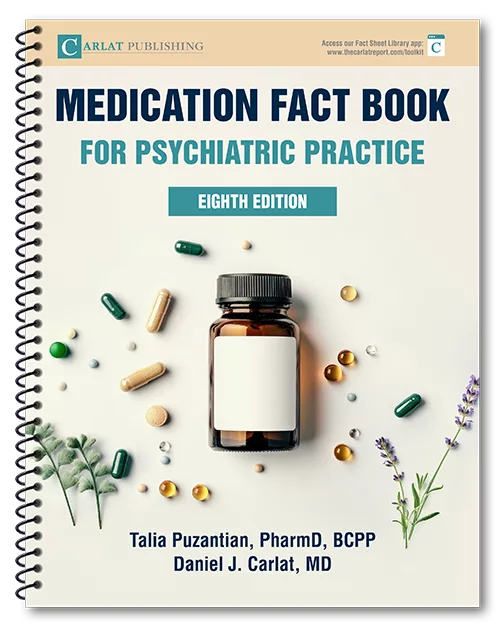
  • MFB8e_SpiralCover.png

    Medication Fact Book for Psychiatric Practice, Eighth Edition (2026)

    Updated 2026 prescriber's guide.
    READ MORE
Featured Video
  • KarXT (Cobenfy)_ The Breakthrough Antipsychotic That Could Change Everything.jpg
    General Psychiatry

    KarXT (Cobenfy): The Breakthrough Antipsychotic That Could Change Everything

    Read More
Featured Podcast
  • RogerSolomon2023.jpg
    General Psychiatry

    EMDR in Practice: A Clinician's Guide to Trauma Reprocessing with Roger Solomon, PhD

    Dr. Roger Solomon provides a comprehensive introduction to Eye Movement Desensitization and Reprocessing (EMDR).

    Listen now
Recommended
  • Join Our Writing Team

    July 18, 2024
    WriteForUs.png
  • Insights About a Rare Transmissible Form of Alzheimer's Disease

    February 9, 2024
    shutterstock_2417738561_PeopleImages.com_Yuri A.png
  • How to Fulfill the DEA's One Time, 8-Hour Training Requirement for Registered Practitioners

    May 24, 2024
    DEA_Checkbox.png
  • Join Our Writing Team

    July 18, 2024
    WriteForUs.png
  • Insights About a Rare Transmissible Form of Alzheimer's Disease

    February 9, 2024
    shutterstock_2417738561_PeopleImages.com_Yuri A.png
  • How to Fulfill the DEA's One Time, 8-Hour Training Requirement for Registered Practitioners

    May 24, 2024
    DEA_Checkbox.png
  • Join Our Writing Team

    July 18, 2024
    WriteForUs.png
  • Insights About a Rare Transmissible Form of Alzheimer's Disease

    February 9, 2024
    shutterstock_2417738561_PeopleImages.com_Yuri A.png
  • How to Fulfill the DEA's One Time, 8-Hour Training Requirement for Registered Practitioners

    May 24, 2024
    DEA_Checkbox.png

About

  • About Us
  • CME Center
  • FAQ
  • Contact Us

Shop Online

  • Newsletters
  • Multimedia Subscriptions
  • Books
  • eBooks
  • ABPN Self-Assessment Courses

Newsletters

  • The Carlat Psychiatry Report
  • The Carlat Child Psychiatry Report
  • The Carlat Addiction Treatment Report
  • The Carlat Hospital Psychiatry Report
  • The Carlat Geriatric Psychiatry Report
  • The Carlat Psychotherapy Report

Contact

carlat@thecarlatreport.com

866-348-9279

PO Box 626, Newburyport MA 01950

Follow Us

Please see our Terms and Conditions, Privacy Policy, Subscription Agreement, Use of Cookies, and Hardware/Software Requirements to view our website.

© 2026 Carlat Publishing, LLC and Affiliates, All Rights Reserved.